adsense analytic

Showing posts with label materials. Show all posts

Tuesday, March 24, 2020

Staircase Dimensions - How to Calculate Properly

Staircase measurements are a significant piece of staircase security. This page covers the entirety of the significant staircase estimations and a slip-up to keep an eye out for! Staircase dimensions are an important part of staircase safety. Here isn this article we cover all of the important staircase measurements and mistakes not to ignore.
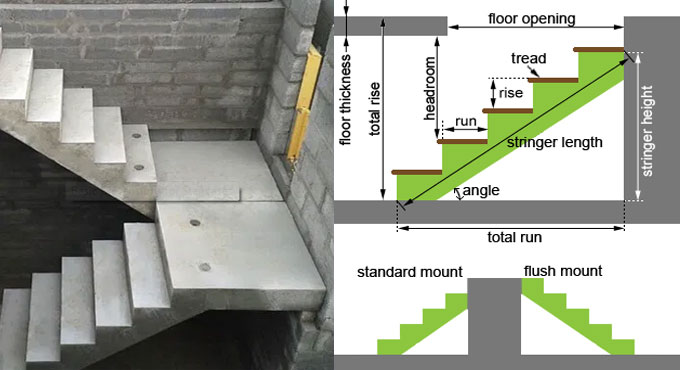
Treads and Risers: The tread size (min 10ins/25.4cm) is directed by the normal grown-up foot size, despite the fact that it isn't important to have the option to accommodate your whole foot on a tread all together for strolling up the stairs to be both agreeable and safe.
The riser height (max 7¾ins/19.7cm) is constrained by the manner by which we descend the stairs. Things being what they are, you could move up definitely more than 7¾ inches effectively and you could descend unquestionably more than 7¾ inches effectively on the off chance that you are confronting in reverse. The rungs of a stepping stool are set at progressively like 12ins/30cm separated. However, we go down the stairs confronting advances, and it's this that restrains the riser size to being a lot smaller.
The most extreme measurement between balusters is 6ins/15.2cm. I don't know for certain what this depends on, however I'm thinking the thought is that it shouldn't be anything but difficult to get a foot or arm caught in the middle of a baluster. Having said that there are a lot of staircase plans where the external handrail has greater holes or is missing through and through.
Staircase estimations: To compute the run of the stairs, just duplicate the tread measurement (guarantee this does exclude the nose - see underneath) by the quantity of steps.
To figure the rise of the stairs, increase the rise measurement by the quantity of steps.
Or on the other hand, to turn out what number of steps you need, take your ceiling height and separation by suppose 16 to begin with. On the off chance that you think of a riser that is a sensible size and not exactly the greatest measurement shown above you need 16 stages. Have a go at partitioning your ceiling height by different numbers until you concoct a riser measurement that works.
Staircase Dimensions - How to Calculate Properly
~~~~~~~~~~~~~~~~~~~~~~~~~~
Published By
Rajib Dey
www.constructioncost.co
~~~~~~~~~~~~~~~~~~~~~~~~~~

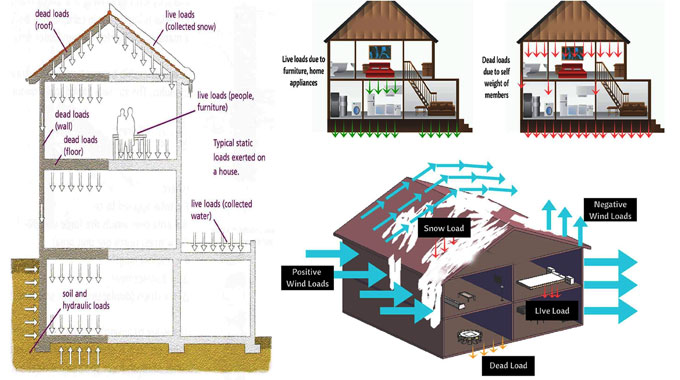
Structural Load Analysis of a Construction

Structural analysis is a significant piece of a design of structures and other constructed resources, for example, scaffolds and passages, as structural loads can cause pressure, twisting and uprooting that may bring about structural issues or even disappointment.

The structure guidelines necessitate that structures must be designed and worked to have the option to withstand all load types that they are probably going to look at during their lifecycle.

There are various sorts of load that can follow up on a structure, the nature of which will change as indicated by the design, use, area and materials being utilized. Design necessities are commonly indicated as far as the greatest loads that a structure must have the option to withstand.

Loads are commonly named either dead loads (DL) or live loads (LL). Dead loads allude to the structure's self weight and for the most part stay consistent during the structure's life. Live loads, for example, traffic loads may fluctuate.

Loads may likewise be classified as:

Concentrated loads (or point loads): Single loads that demonstration over a generally little zone, for example, column loads.

Line loads: Loads apply a load along a line, for example, a parcel's weight on the floor.

Distributed (or surface) loads: These apply a load over a surface zone, for example, the heaviness of floors and roofing materials.

Dead loads (DL): Dead loads, otherwise called perpetual or static loads, are those overwhelmingly connected with the heaviness of the structure itself, and thus stay stationary and moderately consistent after some time. Dead loads may incorporate the heaviness of any structural components, lasting non-structural segments, relentless installations, for example, plasterboard, worked in cabinets, etc.

Structural Load Analysis of a Construction

~~~~~~~~~~~~~~~~~~~~~~~~~~
Published By
Rajib Dey
www.constructioncost.co
~~~~~~~~~~~~~~~~~~~~~~~~~~
Saturday, March 14, 2020

Advantages and Disadvantages of On-site and Off-site Construction

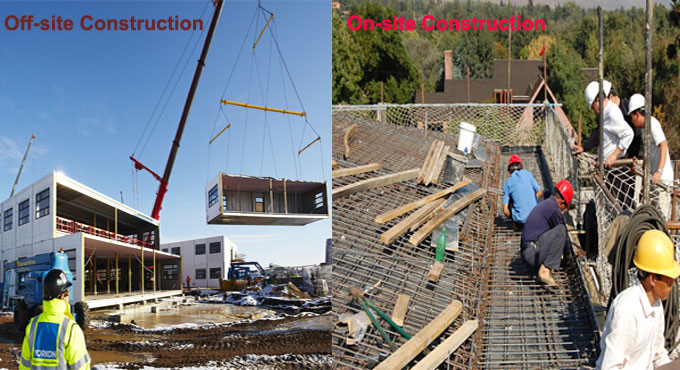
The needs and restrictions at your construction project may make you choose between one of the two main methods of construction: on-site and off-site. Both are widely used in today’s construction industry, depending upon the requirements at the site and according to design.

What is On-Site Construction?
On-site construction is the more traditional method. Here, structures are assembled from raw materials at the site itself, hence the name. The method has to be carried out sequentially and materials needs to be stored and used at the site.


What is Off-Site Construction?
With modern technologies, off-site method of construction has become possible. In this, parts or blocks of the structure are constructed in a designated factory or yard in standardized process. Then, these pre-built blocks are carried to the project site where they are assembled together to form the structure.


Both of the above methods have their own advantages and disadvantages, which make them suitable to different scenarios. Let’s discuss them below.

On-Site Construction

Advantages:

1. Customized Design: Since there is no restriction on what shape of objects are available of construction, there are limitless customization options in this manner. In fact most non-standard designs have to rely upon the on-site method just for this.
2. Alteration: After the construction you can easily modify the structure with this method. It doesn’t require you to depend upon third-party construction factories to add or change a room in your house that has been constructed in the traditional method.
3. Space-friendly: Transporting precast blocks in tight urban areas can get simply impossible. More often, it’s prohibitively expensive. In these scenarios you have no choice but to construct everything on-site.
Advantages and Disadvantages of On-site and Off-site Construction

~~~~~~~~~~~~~~~~~~~~~~~~~~
Published By
Rajib Dey
www.constructioncost.co

~~~~~~~~~~~~~~~~~~~~~~~~~~
Friday, March 13, 2020

Minimum Foundation Depth for Houses

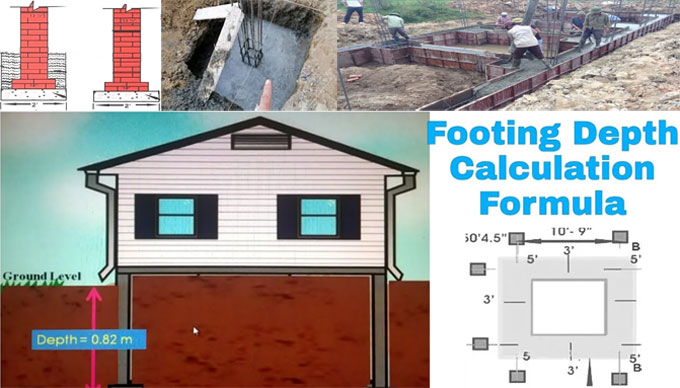
The foundation of a house is what holds the structure up, carries its entire weight. When you try to design a new building, you must consider how deep the foundation should be in order to properly support the building. This is called the foundation depth. It is measured by the vertical distance between the footing and the natural ground surface.
Expansive Soil: One thing to be kept in mind here that light soil has expansive properties. Due to wet and dry weathers, the soil can inflate and condense accordingly. This changes the effective natural ground surface level.
As a rule of thumb, foundations are placed under this level of soil, where such changes do not occur. That is about a meter in depth, in most cases.
However, this can be significantly higher if you have expansive soil or black cotton soil on site. This type of soil can take a load of 200-300 kpa only. Any more and the building will settle.
Groundwater Under Soil: Also, another thing to be kept in mind when deciding the minimum foundation depth is the presence of water under the ground. If the groundwater table is close to the foundation, then the soil under the foundation can flow around.
Water seeps up into the soil and makes it weak. To resist this, the bottom of the footing should be placed at a deep enough place where groundwater does not seep into the soil any more.
Cold Regions: Frost changes the nature of soil. It heaves the soil upward and that may create cavities underground. For this reason, in cold regions where snowing and/or ground frosts are normal, the foundations for outside columns or walls should be placed below the level down to which frost can affect the soil.
In the northern US, this can be as deep as 1.5 meters. Further, if the internal walls are heated, then the outer walls would require a deeper foundation so that the heat does not alter the soil properties.
Minimum Foundation Depth for Houses
~~~~~~~~~~~~~~~~~~~~~~~~~~
Published By
Rajib Dey
www.constructioncost.co
~~~~~~~~~~~~~~~~~~~~~~~~~~

Saturday, February 8, 2020

External Plastering Work Checklist - To follow in Building Construction

The external plastering work in a building project is a pretty important work because it provides the outer finish of the building. Not only that, it is the foundation for the building’s aesthetics. For these reasons, every constructor should keep in mind some basic steps in order to do it right. As such, the following checklist can be very helpful in external plastering work in building construction.
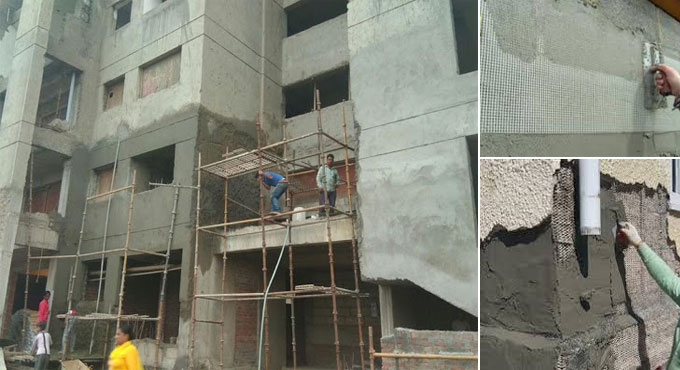
1. Clean the surface: Make sure that the external surface of the building is clean. That means the block or brick masonry and concrete surface. These should be clear of dust, oil grease, loose materials, mortar dropping, nails, wood, metal strips, etc. You should have an even, smooth surface to work on. Otherwise the bonding will not work.
2. Make scaffoldings: You need to erect a scaffolding in order to reach the entire outside surface. Conversely, you might be needing a double scaffolding as well. You have to do this without making a hole in the wall. Since in this phase you must not damage the wall in any way. However, if authorities permit, you can take support from other parts of the building.
3. Mortar and socketing: The gaps between the masonry and the beams that show on the outside needs to be filled with rich mortar. Also, you need to finish out the socketing works.
4. Chicken mesh: Then, fix a chicken mesh on the joint of RCC and masonry wall. The mesh should be 6 inches wide. Nail this mesh at 230mm intervals only.
5. Plumb measure: Use the plumb (also the line) from top to bottom to ensure the accuracy of the plastering.
The plastering here should be of a single coat of 10-12mm only. Also, you must check all the edges.
6. Handle jutting out stuff: Sometimes, a beam or a column, or other parts of construction may be budging out of the plastering. In this case, first take approval of the designer to see if you can break it off. If you can, then use a sharp chisel or hammer to break off the jutting-out portion. Also, you can use a concrete breaker in this. Do take care that it doesn’t hurt any other part of the building.
External Plastering Work Checklist - To follow in Building Construction
~~~~~~~~~~~~~~~~~~~~~~~~~~
Published By
Rajib Dey
www.constructioncost.co
~~~~~~~~~~~~~~~~~~~~~~~~~~
Thursday, June 27, 2019

Major responsibilities of a contractor in construction project

In this civil engineering article, you will get the details about the role of a contractor and the liabilities of him.

Normally, a contractor has to plan, implement, supervise, examine and direct a building construction project from beginning to completion devoid of the scope of the project. The contractor verifies that the project abides by all the specifications as provided in the contract documents.

1. Role Of A Contractor In Project Planning

The project management team develops a master schedule for the project depending on the completion date of the project.

To finish the project on scheduled time according to master schedule, the contractor has to take the following responsibilities :

• Plan for all the important project development and execution details beforehand.
• Specify and evaluate different project issues like the necessary materials, equipment, and personal requirements.
• Anticipate any probable changes.
• Execution of a trustworthy communication strategy between all concerned stakeholders.
• Focus on all legal and regulatory issues and requirements.
• Draft an efficient safety policy.

2. Role Of A Contractor In Project Management

Since the contractor is responsible to finish the project on scheduled time, he should bear the following responsibilities in project management.

• Making funds to accomplish construction tasks.
• Organize the materials for different tasks as projected.
• Arrange necessary construction equipments.
• Appoint required subcontractors to finish the job.
• Submit bills for the completed tasks as mentioned in the contract.

3. Role Of A Contractor In Project Monitoring

To finish the project according to specifications and minimize different issues in the project, a contractor has to take a vital role in project monitoring. He has to perform the following key responsibilities in this field.

• Track time schedule.
• Apply cost-effective methods.
• Check work quality.
• Execution of materials management system.
• Monitor problems associated with safety.

4. Role Of A Contractor In Legal And Regulatory Issues

The contractor also plays an important role in legal and regulatory issues. Besides, he has to check that the project isn’t breaching any legal terms.

• Ensure that the project is in accordance with all the required legal and regulatory issues.
• Obtaining all the required permits prior to progressing with the project.
• Paying or making sure to disburse all the fees and taxes essential to finish the project.

5. Role Of A Contractor In Health And Safety Issues

The contractor has to undertake the following liabilities for health and safety issues.

• Maintain health and safety in the workplace.
• Execute a safety method and standards for the project.
• Apply the proper safety equipment in the project.
• Execution of well organized risk management and communication strategies.
• Provide safety awareness among workers.

Read more

Major responsibilities of a contractor in construction project

~~~~~~~~~~~~~~~~~~~~~~~~
Published By
Rajib Dey
www.constructioncost.co
~~~~~~~~~~~~~~~~~~~~~~~~

Monday, April 17, 2017

Download online construction estimate calculator to estimate the quantities of materials

The absolute volume method is used to work out the material quantities for forming the necessary quantity of concrete on the basis of specified mix proportions. This method is formulated following the principle that the volume of fully compacted concrete is equivalent to the absolute volume of all the materials of concrete consisting of cement, sand, coarse aggregates and water.

Depending on the type of structure, a concrete structure may contain beams, slabs, columns and foundations etc. The volume of concrete essential for concrete structure is computed by summation of the volumes of every structural member or each parts of the members. The formula for computing the volume of a rectangular cross sectional member is length x width x height (or depth or thickness). Appropriate formula should be applied for various cross-sectional shapes of members.


Download construction estimate calculator


~~~~~~~~~~~~~~~~~~~~~~~~
Published By
Rajib Dey
www.constructioncost.co
~~~~~~~~~~~~~~~~~~~~~~~~


Tuesday, April 4, 2017

Make your estimating, project management and bidding process smarter with ProContractor

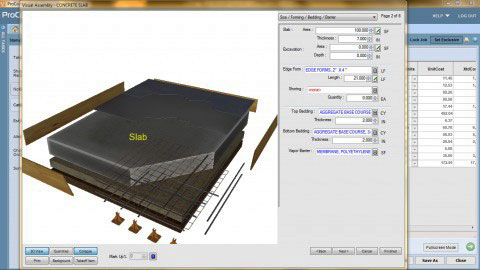
ProContractor is a useful construction software developed by Viewpoint. The software can handle the whole project lifecycle from bid to project completion by providing all-in-one solution for estimating, project management, and accounting.

ProContractor is operated through the cloud with the viewport’s partner CloudJumper. Supported by a strong and scalable platform, CloudJumper offers a workspace as a service (WaaS) platform –providing the users the capability to virtualize their desktop and get access to ProContractor from any remote location at any time.

ProContractor facilitates the contractors to save huge time and win more work by generating takeoffs, estimates, and proposals efficiently. Right-fit features are specifically created for general contractors in residential and commercial construction, concrete, masonry contractors and other specialty trades together with earthwork and excavating contractors.

Given below, some exclusive features of the software :-
• ProContractor improves the speed and perfectness for continuous takeoff and estimating
• It applies digital takeoff to minimize the cost and disputes which may arise for applying paper plans. So, incomparable accuracy can be achieved.
• Instantly and perfectly estimate costs for labor, materials, and equipment
• Yield more bids in fewer time with superior profit margins
For more information, go through the following link
viewpoint.com/products/procontractor-by-viewpoint
Make your estimating, project management and bidding process smarter with ProContractor

~~~~~~~~~~~~~~~~~~~~~~~~
Published By
Rajib Dey
www.constructioncost.co
~~~~~~~~~~~~~~~~~~~~~~~~

Thursday, July 28, 2016

BSF admixtures help to maintain sustainability in concrete and cement

Both concrete and cement play an important role for several construction projects. Concrete is primarily formed with cement, water and grains of stone. Cement is developed by mixing calcium silicate with portions of aluminum and iron compounds.

The following construction video explains the total procedure for creating these materials.

This animated construction video also focuses on the functionality of concrete superplasticizer Glenium to make the best use of these materials for making concrete more flexible, long-lasting and resilient.

BASF Glenium superplasticizers enhance the structural properties of concrete as well as its eco-friendliness.

By applying BASF's concrete admixture Glenium, up to 50 percent of the cement clinker is substitued with other materials. These materials consist of fly ash, a byproduct of coal-fueled electric power plants, or blast furnace slag obtained throughout steel production and recycled for these purposes. Thus, Glenium admixtures facilitates savings of up to 60 percent carbon in concrete production. So Glenium is very vital element to reduce carbon emissions in cement production.


~~~~~~~~~~~~~~~~~~~~
Published By
Rajib Dey
~~~~~~~~~~~~~~~~~~~~

Tuesday, February 2, 2016

Automatic structural steel fabrication system

This construction video shows the detailed process for structural steel fabrication automatically. Steel fabrication is the process for developing metal structures through cutting, bending, and assembling processes.


It is a value added procedures that engrosses the construction of machines and structures out of several raw materials. A fabrication shop will bid on a job, generally on the basis of the engineering drawings, And if the contract is alloted the project will be built up by the contraftor.


~~~~~~~~~~~~~~~~~~~~~
Published By
Rajib Dey
~~~~~~~~~~~~~~~~~~~~~

Monday, January 25, 2016

Engineering Libraries – An exclusive construction app for Civil & Structural Engineers

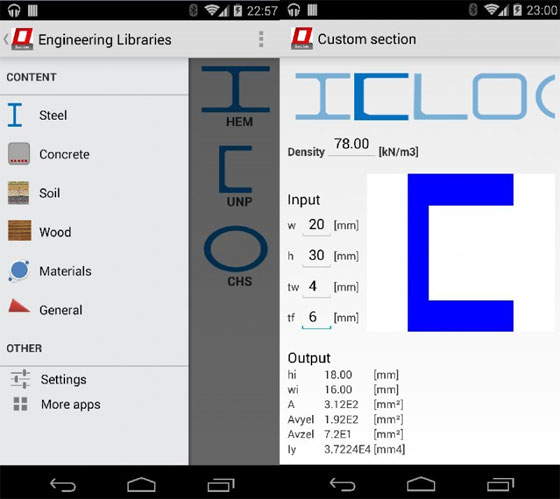
LetsConstruct, the leading developer of various android based engineering apps, is the creator of Engineering Libraries.

It is a useful construction app for Civil & Structural Engineers to collect information for the construction industry. This construction app can be applied for the following :-

• Steel
• Concrete
• Wood
• Soil
• Materials
• General profiles (circular & rectangular)
• Includes EU, US, CA, RU, UK, AU steel profiles
• Metric & Imperial(see options)


The most updated version is Engineering Libraries v0.88 that contains updating to material design as well as concentrated on steel profile Parametric profiles and Freeform sections.


Engineering Libraries

~~~~~~~~~~~~~~~~~~~~~~
Published By
Rajib Dey
~~~~~~~~~~~~~~~~~~~~~~

Friday, January 22, 2016

How to estimate the quantities of masonry works

In a Masonry work, the cement and delicate aggregates devoid of any coarse aggregates are applied for constructing a structure. There exist various types of masonry work:

1. Brick Masonry
2. Concrete block / brick masonry
3. Stone / rubble masonry
4. Clay tiles, etc.

Masonry works like brick masonry, concrete block, stone or rubble masonry are usually estimated with volume, but in some cases these are computed with regard to area where the thickness of masonry is confined to single brick or single block. Tiling is estimated in area.

To estimate the quantities of masonry work, the wastage of materials like bricks, cement or sand as well as the types and classes of bricks, blocks or tiles are not considered. All types of masonry works are calculated individually into categories to estimate the perfect cost of construction on the basis of its price.

To estimate masonry works, the guidelines given below should be maintained:-

1. Masonry is computed as “net in place” containing deductions for openings like doors, windows, ventilation etc.

2. Various shapes of masonry units are individually estimated which range from rectangular, circular etc.

3. Masonry at various heights is estimated individually as masonry at greater elevation from ground may need scaffolding and hoisting.

4. Masonry work is estimated independently in the following diverse: a. Facings, b. Backing to facings, c. Walls and partitions, d. Furring to walls, e. Fire protection


~~~~~~~~~~~~~~~~~~~~
Published By
Rajib Dey
~~~~~~~~~~~~~~~~~~~~

Wednesday, August 5, 2015

A wide array of Construction Accounting & Construction Management Software from Eque2

Eque2 offers a wide array of construction software useful for accounting, estimating, house building, onshore/offshore construction asset management or contracting solution towards small contracting companies as well as multinational or international construction or contracting company.

This construction accounting software will help small to medium firms to maintain & manage their costs as well as track budgets. Besides, one can track, record and distribute data on subcontractor activity, and deal with purchase orders and invoices for reporting purpose efficiently.

This software is used to observe cashflow and control variations as well as trim down costs and increase margins with improved efficiency. With this construction software, one can meet contract budgets, handle purchase orders and invoice and record subcontractor data.
Differentiate amid perpetual, subscription and open-source licenses to find out the perfect model that is most financially suitable for your business.

It is useful construction management software that offers advanced and customizable business management solutions for large and complex construction and contracting organizations to effectively manage their commercial, financial and operational processes.
EVision provides unmatched construction-specific features direct to your users and you can get complete control over your commercial, financial and operational processes. Improve the effectiveness of your project as well monitor, supervise and report on the functionality of subcontractors and suppliers.

This construction software helps you to optimize your resources and make sure that margins are sustained by producing uniform and perfect data from initial phase to post-contract work during your business. EValuate can instantly generate precise and reliable tenders, budget cost plans, valuations and final accounts. It is user-friendly and performs over a diversified business functions.
EValuate Lite refers to the integrated, single-user version of the EValuate construction pricing software, that includes all the features necessary to classify, compute and price work on the various routes concerning project procurement.


This software can be used to control and track in all the people, materials, equipment and services which are delivered to the offshore/onshore industries in real-time. Besides, it also evaluates equipment servicing and maintenance and bill for multiple projects at multiple rates.

This software helps to deal with each phase of the house building process more efficiently, from preliminary land appraisals and acquirement, right through the construction phases, to sales and marketing and finally, to customer care.

ENR online construction webinars

~~~~~~~~~~~~~~~~~~~~
Published By
Rajib Dey
~~~~~~~~~~~~~~~~~~~~

Monday, April 27, 2015

JobFLEX Pro is the next generation estimating app

JobFLEX™ is going to launch the latest version of its mobile compatible estimating app alias JobFLEX Pro. This newest estimating app is available in Google Play™ free of charge in Spring, 2015.

With JobFLEX, the users can generate error free professional estimates instantly in the office or in the field devoid of any 4G or Wi-Fi Connection.

The free Google Play version of the app comes with the following attributes :-

  • Generate estimates from any location devoid of any 4G or Wi-Fi connection
  • A new easy-to-use and compact interface
  • Quick in-app access to account settings
  • Extensive materials list which can be easily created and edited from any remote location
  • Assign photos in estimates to get an clear conception
  • Adaptable format for a single estimate
  • Preview, email, or print estimates with just one click
  • Unrestricted customer support

For enjoying more advanced features, the users can use the updated versions alias JobFLEX Basic or Pro package. All the project files ranging from customer information, photos, quotes/estimates, job sheets, etc. are uploaded to a protected File Directory and the users can avail these files later, out of a mobile gadget or a computer.

There a version of JobFLEX Pro, for companies with several users, contains the File Directory feature together with a CRM, scheduling tools, and reports.

JobFLEX™ is offering a beta testing program for beta testers and reviewers to make assessment of this new estimating app.

Selected beta testers will then be offered to use the JobFLEX Pro version at free of cost for six month (a $600 value). Beta testers and reviewers should have to apply an Android device and perform and/or publish in one of the following industries to meet the criteria:

  • Construction-General Contracting, HVAC, Plumbing, Roofing, Electrical, Landscaping, Remodeling, etc.
  • Service-Catering, Sign Companies, Advertising, Sales Reps, Specialty Services, etc.

In order to participate in beta testing program, visit www.job-flex.com/early-access.

For getting more updates, visit www.job-flex.com

JobFLEX Pro is the next generation estimating app

~~~~~~~~~~~~~~~~~~
Published By
Rajib Dey
~~~~~~~~~~~~~~~~~~

Saturday, January 3, 2015

Sustainability in construction and civil engineering

Sustainability is one of the important aspects of the engineering. It protects the project from surroundings and living eco-system.

The projects involve use of machine, structure demolition, using green premises and many more.

The reason for sustainability:-
  • Generation of waste material
  • Vehicular emission
  • Noise pollution of heavy machine and vehicular use.
  • Discharging waste materials.
Waste products: The waste products could create harm to environment. It is advisable to reuse it after minimization of waste.

These are some steps that make the construction-misuse suitable,

Eliminate – Avoid constructionsquander in the first place.

Reduce – Reduce the amount of waste you produce.

Reuse – Recycle the construction wastes.

Recover – Reprocess after reused it.

Dispose – Arrange of what is left in right way.

Building materials: Use of river sand and gravel has some harmful impact on the construction. It needs mining on the river bed misbalanced the eco-system. Now the use of alternate building materials is rising.

Now hit this link to get more knowledge about it. Now a day, the use of green building has been increased. These are energy efficient buildings. Otherwise transparent concrete can be used.

Some tips and tricks:-

First of all, decrease the supply chains reducing transport costs.

Train waste minimization and reprocessing the construction.

Building orientation is important. Mark it as it can reduce the energy.

Sustainability in construction and civil engineering

~~~~~~~~~~~~~~~~~~~
Published By
Rajib Dey
~~~~~~~~~~~~~~~~~~~