adsense analytic

Showing posts with label Structural. Show all posts

Monday, March 30, 2020

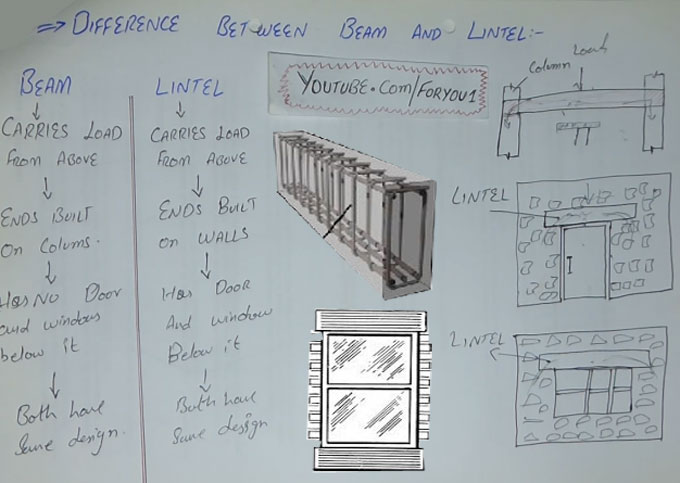
How beam and lintel differs as per structural behavior & load carrying system

This construction video tutorial briefly explains the variations among beam and lintel.
Both the beam and lintel are flexural as well as horizontal members and considered as the vital parts of structural system. But these differ according to their structural behavior and load carrying system.
Given below the points of differentiation:-
How beam and lintel differs as per structural behavior & load carrying system
~~~~~~~~~~~~~~~~~~~~~~~~~~
Published By
Rajib Dey
www.constructioncost.co
~~~~~~~~~~~~~~~~~~~~~~~~~~

Friday, August 23, 2019

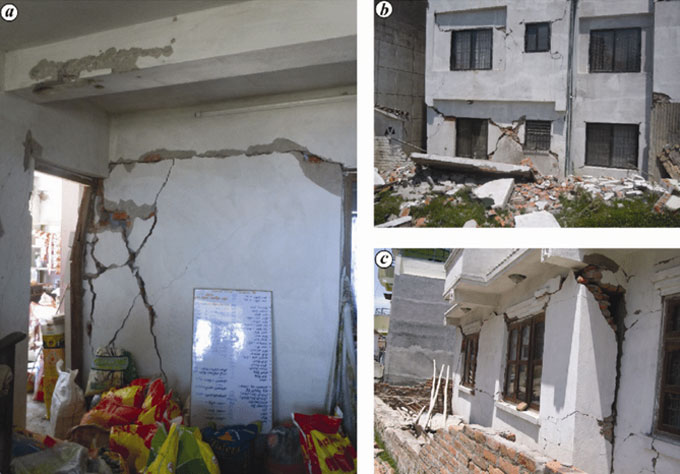
Details about structural and non structural defects in buildings

Concrete has diversified nature. It casts in place by including or excluding reinforcement. It is also precast or pre-stressed to attain necessary strength. For this purpose, there should be adequate knowledge on the behavior and constituents based on which the concrete is produced.
There should not be any type of laxity in any of its phase like placement, design & maintenance as these can create deterioration and resist concrete to accomplish its proposed functions. Given below, some vital factors which can weaken the quality of concrete:
1. Accidental loading
2. Chemical reaction like sulfate attack, alkali carbonate reactions, alkali silica reactions etc
3. Erosion of steel reinforcement
4. Inferior construction detailing
5. Erosion
6. Freezing and Thawing
7. Shrinkage
8. Settlement
9. Fire and weathering
Flaws in Building Design: Due to deficient structural design, the concrete is uncovered to flexural and shearing stresses and as a result spalling and cracking of concrete are developed. Any sudden modification in cross section of any member can result in raising the stress concentration in that member that leads to cracking of concrete.
Deflection is considered as one of the significant part in structural design. If there exist any issue in its consideration throughout design, that can produce cracking of concrete. Insufficient arrangement of drainage and expansion joints throughout the design also leads to deterioration and spalling of concrete.
Flaws During Construction: Flaws throughout building construction vary from inappropriate mixing, placing and curing of concrete. Detachment of shoring & formwork can also produces cracks in concrete.
When extra water is provided in concrete to enhance the workability of concrete, the water cement ratio is raised significantly and it can reduce the strength of concrete. Inappropriate alignment of formwork produces corrosion in concrete.
Structural Defects in Building Construction - The following structural defects are found in buildings:
1. Cracks in foundation (substructure)
2. Cracks in floors and slabs (superstructure)
3. Cracks in Walls (superstructure)
These above defects are occurred due to the following factors:
1. Inappropriate soil analysis
2. Inappropriate site selection
3. Application of defective materials
4. Inferior work
These structural issues can be resolved with perfect design and planning.
Non Structural Defects in Building Construction - The following non structural defects are common in buildings:
1. Defects in brick work
2. Dampness in old structures
3. Defects in plaster works
So, it is found that minimum design and construction defects lead to minor cracking or spalling which can weaken the concrete and result in collapsing of the structure. To get rid of these issues, proper care and attention should be taken in designing, detailing and construction of concrete structure.
Details about structural and non structural defects in buildings
~~~~~~~~~~~~~~~~~~~~~~~~
Published By
Rajib Dey
www.constructioncost.co
~~~~~~~~~~~~~~~~~~~~~~~~
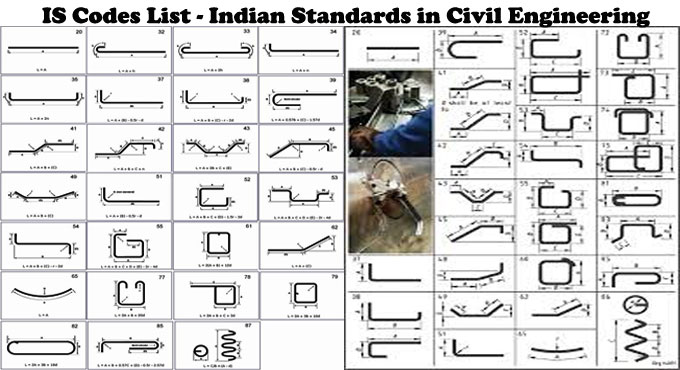
Commonly used Indian Standard Codes (IS codes) for civil engineers

IS stands for Indian standard. Each country possesses their own code book identical to that India contains IS code book for RCC, steel structure. The IS codes includes numerous standards and methodology for construction, raw material used, structural analaysis and other provisions.
It comprises of some data based on which a civil engineer design the structure. It contains some pre defined formulae and data.
Civil engineers who perform construction activities of big projects generally should be well versed with a wide array of IS codes since such projects require different types of construction materials in several structures like buildings, roads, steel structures, all sorts of foundations etc.
Given below, detailed lists of some IS codes which are extensively used by construction engineers.
IS 456:2000: Plain and Reinforced Concrete - Code of Practice (Download link bit.ly)
IS 383:1970: Specifications for fine & coarse aggregate from natural sources for concrete (Download link drive.google.com)
IS 2386 (Part I) 1963: Methods of Test for Aggregates for Concrete, Part I: Particle Size and Shape (Download link drive.google.com)
IS 2386 (Part II) 1963: Methods of test for aggregates for concrete, Part II: Estimation of deleterious materials and organic impurities (Download link drive.google.com)
IS 2386 (Part III) 1963: Methods of test for aggregates for concrete, Part 3: Specific gravity, density, voids, absorption and bulking (Download link drive.google.com)
IS 2386 (Part IV) 1963: Methods of test for aggregates for concrete, Part 4: Mechanical properties (Download link drive.google.com)
IS 2386 (Part V) 1963: Methods of Test for Aggregates for Concrete, Part V: Soundness (Download link drive.google.com)
IS 2386 (Part VI) 1963: Methods of test for aggregates for concrete, Part 6: Measuring mortar making properties of fine aggregates (Download link drive.google.com)
IS 2386 (Part VII) 1963: Methods of Test for Aggregates for Concrete, Part VII: Alkali Aggregate Reactivity (Download link drive.google.com
IS 2386 (Part VIII) 1963: Methods of Test for Aggregates for Concrete, Part VIII: Petrographic Examination (Download link drive.google.com)
IS 2430-1986: Methods for Sampling of Aggregates for Concrete (Download link drive.google.com)
IS 4082-1996: Recommendations on stacking and storage of construction materials and components at site (Download link drive.google.com/)
IS 2116-1980: Sand for masonry mortars – Specifications (Download link drive.google.com)
IS 269-1989: Specification for Ordinary Portland Cement, 33 Grade (Download link drive.google.com)
IS 8112-2013: Specification for 43 grade ordinary Portland cement (Download link drive.google.com)
IS 12269-1987: Specification for 53 grade ordinary Portland cement (BI-LINGUAL) (Download link drive.google.com)
Commonly used Indian Standard Codes (IS codes) for civil engineers
~~~~~~~~~~~~~~~~~~~~~~~~~~
Published By
Rajib Dey
www.constructioncost.co
~~~~~~~~~~~~~~~~~~~~~~~~~~

Saturday, November 5, 2016

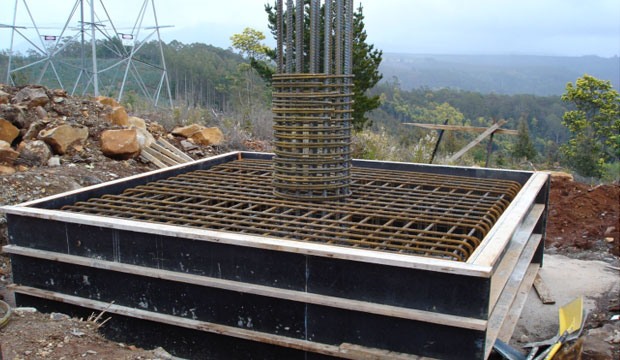
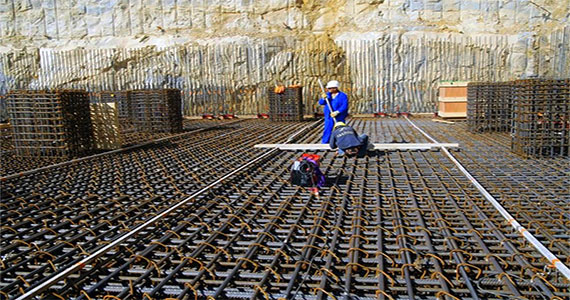
A live demonstration on Raft versus Pile Foundation

If the gaps of footing are nearer, a raft foundation is recommended. Often, basements are created for particular purpose imposing to implement raft foundation. Usually, a raft foundation refers to a floating foundation that includes the ground completely to disperse load.

Pile foundation is mostly used if the spacing of footing is big & soil is costly in nature & it is not reasonable to excavate complete depth of this costly soil below the footing. If the spacing of column is big, raft foundation becomes expensive.

A raft foundation is ideal for feasibly inconstant soils, or soils which are extremely flexible. The raft system decreases the pressure on foundational soils. In some cases, a pile foundation is utilized in equivalent situations as a raft foundation. Piles should be set up intensely to spread to a strong strata of material, like gravel or bedrock.

A raft system will be perfect in some conditions where the depth of silt, sand or fine soil is very deep to develop a pile foundation. A spread footing is also ideal for feasibly unsteady soils. A spread footing needs excavating to a specific depth under the site grade, and considerably wider as compared the footprint of the house, and backfill with condensed, structural gravel fill. As soon as it is positioned, a standard concrete foundation is founded on the structural fill.


~~~~~~~~~~~~~~~~~~~~~
Published By
Rajib Dey
~~~~~~~~~~~~~~~~~~~~~

Friday, September 16, 2016

Benefits of Grillage Foundation

Grillage Foundation design is mostly suitable for heavy structural loads from columns, piers or beams which are essential to transmit bearing capacity of a soil relatively inferior.

The grillage foundation can easily disperse the load over a broad area of the subsoil. This foundation facilitates to resist deep excavations because the required base area is arranged for the load of the transmission. The foundation depth is restricted from 1m to 1.5m.

The grillage foundation contains two or more tiers of beams placed at proper angles to disperse the load over a extensive area.

Usually, this type of foundation is undertaken toward heavy structure columns piers and stanchions. Grillage is made with steel I I section (R.S.J) placed in single or double large.

The second larger - The number of R.S.J.S and they’re spaced separately based on load of the structure and the bearing capability of the soil.

Ground Improvement with inclusion of Load or enhancing operative stress
When load is delivered on the ground, it is compressed. The range and required time may vary according to the placing of ground particles, on the degree of saturation as well as smooth draining of the soil. If load is delivered for loose and specifically unsaturated fills, it can cause quick settlement.

In order to build a grillage foundation, a trench of the essential width and depth is excavated. The trench surface is leveled and rammed. Above the rammed surface, a cement concrete layer is applied. It should be condensed properly to transform it water-resistant. R.S.J.S contain necessary dimension that are place at consistent gaps. For implanting the lower flanges of the R.S.J.S into the concrete, rich cement mortar is poured. The pipes and bolts are used to attach the R.S.J.S collectively. The bolts are pushed into web of the R.S.J.S.

G.I. pipe pieces are arranged among R.S.J.S, and a long bolt is passed over all the holes and pipes. This will attach the R.S.J.S collectively and develop a solid mass.

Grillage Foundation Types

1.Steel Grillage Foundation
Steel Grillage Foundation is developed with steel beams and it is structurally called rolled steel joists (RSJ), applied in two or more tiers.
2.Timber Grillage Foundation
Timber grillage is undertaken for heavy load wood column or masonry wall. Benefits of Grillage Foundations.

Steel grillage foundation is more useful for contractors as compared to wooden grillage.

Installation Speed – Contractors can make significant savings in time through a grillage foundation.

Suitability – Grillage foundations are mostly used in place of poured concrete and huge time is saved because of smooth installation process.

Costs Reduction – Contractor can obtain discount in cost as there is least possibility for disarrangement of transport infrastructure.

Multipurpose foundation solution – The technology supports various applications.


Benefits of Grillage Foundation


~~~~~~~~~~~~~~~~~~~~~
Published By
Rajib Dey
~~~~~~~~~~~~~~~~~~~~~

Saturday, May 7, 2016

Categories And Design Of RCC Slabs And RCC Structures

Reinforced Cement Concrete Slab

  • A Reinforced Concrete Slab Component plays a vital role in a building. It is considered as a useful structural element of the current buildings. There are various columns and beams which provide support to Columns and Beams.
  • The density of RCC Slabs varies from 10 to 50 centimetres which are generally found in developing floors and ceilings.
  • Thin concrete slabs are also utilized for the objective of exterior paving.
  • In several domestic and industrial buildings, a solid concrete slab, sustained on foundations or directly on the sub soil, is utilized to develop the ground floor of a building.
  • Thinner, pre-cast concrete slabs are pushed among the steel frames of tall buildings and skyscrapers to construct the floors and ceilings on each level.
  • At the time of creating structural drawings of the reinforced concrete slab, the slabs are shortened to “r.c.slab” or simply “r.c.”.


Design of various types of slabs and their reinforcement

There are lot of designs available for a suspended slab to develop the strength-to-weight ratio. In most cases the top surface stands flat, and the bottom is modulated:


  • If the concrete is poured into a corrugated steel tray, generally it is called corrugated. It enhances the strength and avoids the bending of slab under its own weight. The corrugations happen on the short dimension, from side to side.
  • A ribbed slab provides significant additional strength on one direction.
  • A one way slab contains structural strength in shortest direction whereas a two way slab contains structural strength in two directions.

These slabs belong to cantilevered or Simply Supported Slabs.


Categories and Design of RCC Slabs and RCC Structures

~~~~~~~~~~~~~~~~~~~~~
Published By
Rajib Dey
~~~~~~~~~~~~~~~~~~~~~

Monday, April 4, 2016

How to set up stone veneer to the exterior of your home to give it an elegant look

Rae Young briefly shows through this youtube construction video to set up Stone Veneer in exterior of your home to give an elegant look.

Stone veneer is a useful construction material to be applied as a preventive and fancy covering for outward or inward vertical walls and surfaces. The veneer is generally 1 inch thick and its weight should be below 15 pounds per square foot (73 kg/m2)in order to avoid any extra structural supports.

Stone veneer is built with natural stone and manufactured stone.

Natural stone veneer is developed with real stone that belongs to either collected, i.e. fieldstone, or quarried. The stone is sliced to a uniform thickness and weighted to be applied as a veneer. This stone is usually known as thin stone veneer.

Manufactured stone veneer refers to an attractive building material built to reproduce the look of natural stone. Various types of artificial stones, faux stone, stacked stone veneer, manufactured stone, and flexible stone veneer are also utilized for manufactured stone veneer.

Manufactured Stone veneer is formed by pouring a lightweight concrete mix into rubber forms having various styles. It is then colored to make it real stone. Then the produced stone veneer is added to walls through special mortars.

Flexible stone veneer is produced by dragging a thin layer of stone out of a slab of slate, sandstone, or mica schist. It is supported with a blended material.


~~~~~~~~~~~~~~~~~~~~~
Published By
Rajib Dey
~~~~~~~~~~~~~~~~~~~~~

Monday, March 28, 2016

How to model a Reinforced Concrete Beam with Ansys Workbench

Ansys, a USA based Computer-aided engineering software developer, presents an exclusive construction tutorial on modeling a Reinforced Concrete Beam with ANSYS Workbench. ANSYS Workbench is the most recognized platform to resolve any issue associated with engineering field. Here static static structural analysis method is followed for the modeling purpose.

PLCRACK command is applied to demonstrate failed elements or cracked or crushed elements. Deformation of the Rebar can also be exported. This is a four point bending test of concrete.


~~~~~~~~~~~~~~~~~~~~~
Published By
Rajib Dey
www.constructioncost.co
~~~~~~~~~~~~~~~~~~~~~

Wednesday, December 16, 2015

PROKON 3.0 for structural analysis, design and detailing

PROKON, a software suite that contains forty structural analysis, design and detailing programs to simplify the Structural Analysis and Design process. The PROKON programs were first introduced in 1989, and nowadays PROKON is recognized globally.

The suite is modular type, but its effectiveness remains in the tight assimilation amid analysis, design and detailing programs.

PROKON is evolved and supported by a team of professional engineers and designed for the sake of structural engineers and technicians. The software can easily resolve day-to-day structural engineering problems in least time.

This construction program offers the following functionalities :-

• Frame and finite element analysis.
• Steel member design.
• Steel connection design.
• Reinforced and prestressed concrete design.
• CAD and reinforced concrete detailing.
• Timber member design.
• Masonry design.
• Other structural applications like section properties calculation and section database.

A series of geotechnical analysis modules is also accessible as part of the PROKON suite.

The link for download the latest version alias PROKON 3.0 www.prokon.com


~~~~~~~~~~~~~~~~~~~~~
Published By
Rajib Dey
~~~~~~~~~~~~~~~~~~~~~

Tuesday, December 15, 2015

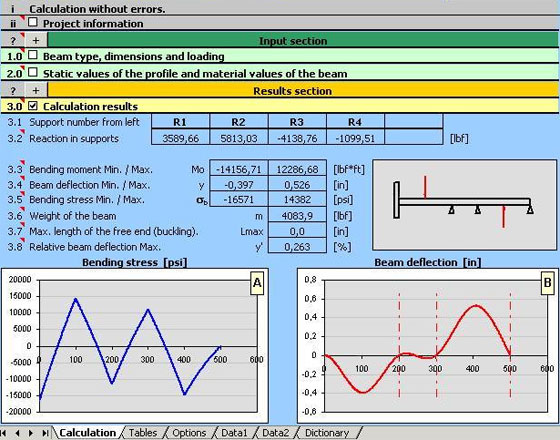
MITCalc Beam Calculation Software for analyzing stress and deflection of the beam

MITCalc Beam Calculation Software is a very handy excel based estimating program from MITCalc. Various constructional professionals like structural & mechanical engineer, design engineer, engineering draughtsman, technical employees can use this estimating program for creating estimation of straight, maximum three times static indefinite beams containing constant axis-symmetrical profiles. This construction application supports multi-language, Imperial and Metric units.

MITCalc Beam Calculation Software offers the following functionalities:

• Clear description of the type of beam and its loading with visual check.
• Estimation of area characteristics of 20 types of cross sections
• Computation of reactions in supports.
• Estimation of least / highest bending moment, stress and deflection of the beam.
• Calculation and graphic demonstration of the moment, stress, deflection and bending angle of the loaded beam.


The application consists of a table of materials and a table of area characteristics of W, S, C, L profiles acc. to ANSI/AISC and I, U, L a T profiles acc. to DIN/ISO. Used standards: DIN 1025, 1026, 1028, 1029, 1024, AISC W, S, C, L, LU. This module is a part of MITCalc - Mechanical and Technical Calculation Package for gear, belt and chain drives, springs, beam, shaft, bolt connection, shaft connection, tolerances and many others.


MITCalc Beam Calculation Software

~~~~~~~~~~~~~~~~~~~~~
Published By
Rajib Dey
~~~~~~~~~~~~~~~~~~~~~

Tuesday, August 11, 2015

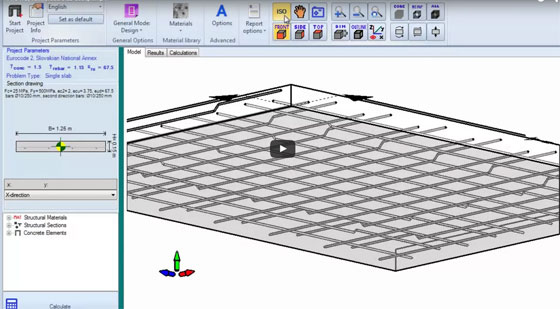
How to use RCsolver software program to make the design of 2-way reinforced concrete slab

Dimitrios Mamoglou, the renowned engineer and software developer, has presented an exclusive video for construction constructor & construction estimator. This video shows how to design a two way reinforced concrete slab through RCsolver software program by following Eurocode 2 specifications.

RCsolver is the kind of software that is used to create the design and computation of reinforced concrete structural members. It makes all the calculations defined in the Eurocodes and ACI 318-11 toward the tensile and shear reinforcement of the structural members.

RCsolver helps the users to have a 3D digital view of the members and the reinforcement rebars. It is combined with Eurocode 2 and 8 specifications, together with the national annexes specifications concerning a great amount of European countries. The latest version of RCsolver consists of the ACI 318-11 specifications focusing concrete member design.

Eurocode 2 and EC2 are both short forms for BS EN 1992, Eurocode 2: Design of concrete structures. There exist four parts to BS EN 1992 but while referring to Eurocode 2 a good number of people suggest BS EN 1992-1-1 general rules and rules for buildings.

For more information, visitwww.eurocode2.info

15-day free trial version is available for users.


2-way reinforced concrete slab

~~~~~~~~~~~~~~~~~~~
Published By
Rajib Dey
www.quantity-takeoff.com
~~~~~~~~~~~~~~~~~~~

Friday, May 15, 2015

How to create footing design through ROBOT Millennium, the powerful Robot structural design software

How to create footing design through ROBOT Millennium, the powerful Robot structural design software
The following construction video shows how to apply Robot Millennium, a powerful Robot Structural Professional Analysis and Design software for computing the footing.

Several structural engineers from all through the globe use ROBOT Millennium for its consistency as well as user-friendliness.

The software provides comprehensive structural analysis solution that involves frame analysis, FEM plates, shells and solid elements, as well as code checks, dynamic analysis, cables and both geometric and nonlinear analysis and various other superior features.

The simple GUI facilitates the user to resolve complicated structures instantly and precisely.

Watch the following online demonstration.


Download Robot Structural Analysis Free Trial

~~~~~~~~~~~~~~~~~~~
Published By
Rajib Dey
~~~~~~~~~~~~~~~~~~~

Thursday, April 23, 2015

How to solve a loading problem regarding structural-slab loading on a column

How to solve a loading problem regarding structural-slab loading on a column
Civil Engineering Academy provides series of video tutorials which are very useful for students to pass the Civil PE Exam successfully. The following video tutorial is a part of their video tutorial series.

This construction video highlights the solution for resolving the loading problem concerning structural-slab loading on a column.

In this video you will find a concrete slab and its thickness is 5”. The loading is also given. Learn how to work out reaction in column B (Kips).


~~~~~~~~~~~~~~~~~~
Published By
Rajib Dey
~~~~~~~~~~~~~~~~~~

Wednesday, April 8, 2015

Renovation Construction Budget Spreadsheet

Renovation Construction Budget Spreadsheet
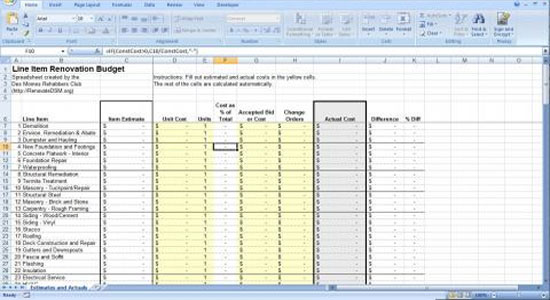
Implementing renovations, alterations or modifications in a construction requires a precisebudget planning. Whether it is a major change or a minor one, line item construction budget spreadsheet helps in preparing cost estimates in an organized and effective manner.

This spreadsheet is very simple to use. Users just need to fill out estimated and actual costs in the yellow cells with budget projections for each of the applicable line items. The rest of the cells are calculatedautomatically. As the project progresses, estimators can use the "Actual Cost" and "Change Order" columns to track their expenditures in relation to their budget projections. The various line items that must be considered to obtain the Total Project Cost include:

Sticks and Bricks: Demolition, New foundation and footings, ConcreteFlatwork- Interior, Foundation repair, Waterproofing, Structural remediation, Termite treatment, Masonry- Tuckpoint/ Repair, Carpentry- Rough Framing, Electrical Service, Water Service, Doors and Windows, Electrical wiring, Doors, Flooring, Painting, Appliances, Miscellaneous Building Materials, etc.

Site: Excavation and Grading, Site improvements, Fencing, Landscaping, etc.

Professional: Consultants like Accountant, Architect, Structural, and others.

Development: Property Acquisition, Property Inspections, Taxes, Insurance, Monthly Utilities like Electric, Gas, Security, Water. Sales Commission, Developer Fee, etc.

Renovation Construction Budget Spreadsheet


Construction Contingency: It is also necessary to provide accurate value for item estimate, unit cost, unit, accepted bid, actual cost, difference and other particulars to attain comprehensive renovation construction budget.


~~~~~~~~~~~~~~~~~~~
Published By
Rajib Dey
~~~~~~~~~~~~~~~~~~~

Saturday, July 5, 2014

The Fluor legacy codes are very useful for construction estimator

In my experience, the best convention for cost codes are numeric. The Fluor legacy codes are the most comprehensive and flexible because of the order of the prime / sub-prime / detail / cost type. The entire cost code including the cost type is contained in 6 characters as follows:
  • 101001
  • 1= Prime (Concrete)
  • 10= Sub-Prime (Concrete / General Account)
  • 10-100= Prime / Sub-Prime with 3 digit Detail (Concrete / General Account / Testing)
To elaborate, the prime supports the natural order of construction as follows:
Direct Accounts
  • 0 account - Site @ Civil
  • 1 account - Concrete
  • 2 account - Structural
  • 3 account - Architectural
  • 4 account - Mechanical
  • 5 account - Piping
  • 6 account - Electrical
  • 7 account - Instrumentation
  • 8 account - Painting, Tracing, Insulation (Other Directs)
Indirect Accounts
9 account - All Indirect costs
Further to the First character, the sub-prime breaks down the prime into a further 10 sub-primes. In the case of an account like electrical, you can establish meaningful commodity based categories at the sub-prime level as follows.
  • 60 = Electrical General
  • 61 = Major Electrical Equipment
  • 63 = Power and control Cable
  • so on and so on...
  • 10-100- 1- Prime / Sub-Prime with 3 digit Detail & Cost Type (Concrete / General Account / Testing / Labour)
  • Personally, I have used the Fluor legacy codes throughout my entire career across a variety of industries ad projects of all sizes. They truly are a set of codes that could be adopted by the AACE or the CII as a best practice coding convention !!!
  • I am happy to answer any questions on applying these codes at any phase of a project.

The Fluor legacy codes are very useful for construction estimator 
~~~~~~~~~~~~~~~~~~~~~~
Published By
Rajib Dey
www.quantity-takeoff.com
~~~~~~~~~~~~~~~~~~~~~~