adsense analytic

Showing posts with label Building materials. Show all posts

Thursday, September 6, 2018

Steel Buildings and their various benefits

Steel buildings are eco-friendly. Any steel structure integrates the organic material and for this reason mould and mildew infestations are not occurred. The steel buildings are 100% recyclable and can be used further.

Steel building construction is mostly recognized for their flexibility and stability. Steel buildings are designed for both permanence and impermanence i.e. they are utilized for storage throughout project execution or for long term preservation of machinery or goods. The steel building can provide the following benefits :-

1. Easy Set Up: The steel frames are fabricated perfectly to adapt collectively with one end skidding into the other. No special fasteners are necessary as well as cutting, retaining, and hammering concurrently long, immense and bulky planks.

2. Cost effective: As the steel is perfectly slashed at the time of manufacturing, no waste occurs in construction site. Less salary is disbursed due to requirement of fewer employees.

3. Environmentally Friendly: The steel buildings are environmentally friendly and they provide good benefits for construction. Steel is the most reprocessed material and several manufacturers utilize recycled steel in all of their steel building materials.

4. Energy Savings: Energy efficiency is another good aspect of an environmentally friendly building. In steel buildings, there are window placement, Tinted Windows, Insulated Frames, Vapor Retarders between the foundation and concrete slab.

5. Safe and stable: Steel frame buildings have strong resistance strength against flame as compared to wood framed constructions. Steel can also resist the attack from termites, bugs or rodents as well as mold or fungi.

It does not require any type of chemical to maintain it’s longevity. A steel frame building is efficiently grounded and less likely to be hit or damaged by lightning.

6. Superior construction quality: A steel frame building does not deteriorate in due course and weaken like wooden structures become over time. So, no need to worry about fragile spots. Steel has also good resistance capacity against corrosion. It is dimensionally steady and there is no distortion with climate changes.

7. Longevity: Steel contains heaviness ratios of any building material. It never buckles, divides, distorts, rotates, chinks, rots or splinters. It’s weight is less as compared to timber. It is can be handled easily and built up with specifically when lifting partitions and roofs.
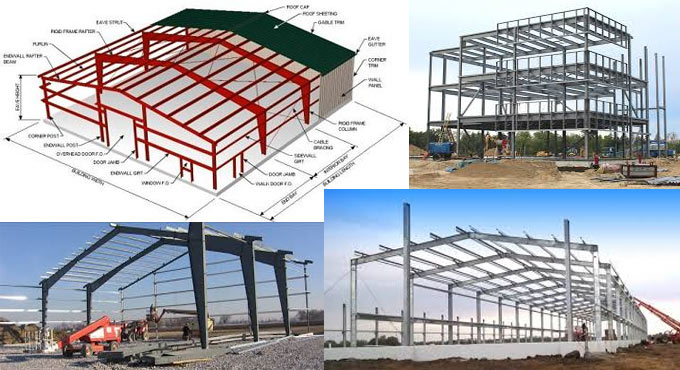
Steel Buildings and their various benefits

Read more

~~~~~~~~~~~~~~~~~~~~~~~~
Published By
Rajib Dey
www.constructioncost.co
~~~~~~~~~~~~~~~~~~~~~~~~

Wednesday, August 22, 2018

Applications and advantages of Slag Cement in concrete construction

Slag cement stands for a hydraulic cement that is developed when granulated blast furnace slag (GGBFS) is crushed by maintaining proper delicacy and utilized to substitute a part of portland cement. It is applied as an independently batched cementitious materials.

It belongs to a restored industrial by-product concerning an iron blast furnace. It mainly contains calcium and aluminum silicates.

Molten slag deflected from the iron blast furnace is chilled instantly. It forms glassy granules that offer required reactive cementitious characteristics when crush into cement fineness.

As soon as the slag is chilled and crushed to an utilizable fineness it is preserved and transported to suppliers. Slag cement is extensively used in ready-mixed concrete, precast concrete, masonry, soil cement and high temperature resistant building products.

The slag cement can improve the functioning of concrete for a long period as well as facilitates the designers to minimize the environmental footprint of concrete whereas assuring superior performance and better stability.

Given below, the various advantages of slag cement application:

1. Superior functionality
2. Simpler placeability and finishability
3. Greater long-standing compressive and flexural strengths

4. Lowered permeability
5. ASR mitigation properties
6. Superior stability and resilience
7. More uniform performance
8. Lighter color


Specifications and Grade:

Grade 80: Slag containing a low activity index

Grade 100: Slag with a moderate activity index

Grade 120: Slag with a high activity index

Application & dosage (% by weight) of slag

Outside flatwork ≤35%
General application 35 to 50%
Mass concrete 60 to 80%


Sulfate resistance
Type II equivalent ≥ 35%
Type V equivalent ≥ 50%
Marine/chemical/heat >50%<80%


The slag cement is used in diverse ways which range from ternary mixtures and soil stabilization etc.

Applications and advantages of Slag Cement in concrete construction


Read more


~~~~~~~~~~~~~~~~~~~~~~~~
Published By
Rajib Dey
www.constructioncost.co
~~~~~~~~~~~~~~~~~~~~~~~~
Thursday, August 9, 2018

How the strength of concrete is influenced by the temperature

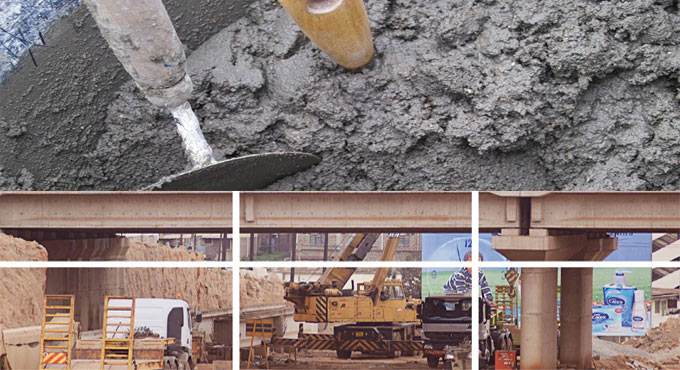
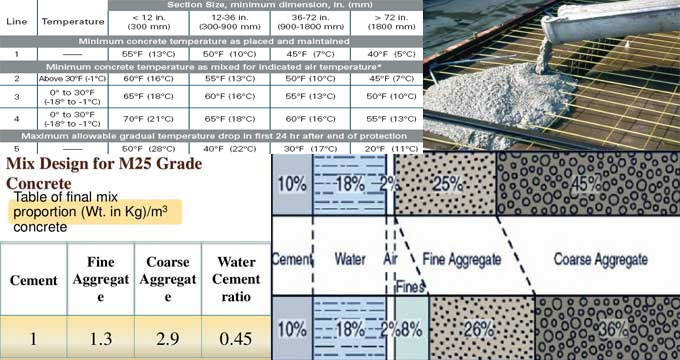
The concrete strength performance in initial phase is significantly affected by the temperature control. In cold weather, the temperatures of concrete should be managed with powerblanket™ concrete curing blankets so that proper compression strengths are attained as soon as possible. Once, the concrete attains the perfect strength, the construction process is started.

The following four phases of works are required for building up RCC column :-
Column layout work
Column reinforcement work
Column formwork
Concrete Pouring into column


Given below, the detail segregation of strength gains after three days at different temperatures:
Temperature – Compressive Strength (psi)
70°F – 2,700
60°F – 2,150
50°F – 1,600
40°F – 1,200
30°F – 850
20°F – 400
In order to keep most favorable concrete strength, the following activities should be undertaken while placing concrete in cold weather:
Utilize a heated or warm concrete mix.
Keep an eye so that the concrete can’t be freezed – Apply powerblanket™ concrete curing blankets to manage temperature.
Ensure that the concrete should be arranged on a frozen sub-grade – Apply powerblanket™ concrete curing blankets to manage temperature.
Safeguard concrete against extreme drying.
Include accelerators to retain strength and normal set time.
Stay away from quick changes in concrete temperature with powerblanket™ concrete curing blankets.
How the strength of concrete is influenced by the temperature


~~~~~~~~~~~~~~~~~~~~~~~~
Published By
Rajib Dey
www.constructioncost.co
~~~~~~~~~~~~~~~~~~~~~~~~
Tuesday, August 7, 2018

Details of Cast in Situ Concrete Piles and their advantages

Cast In Situ belongs to a construction item or structural member similar to a beam or in this case a Pile that should be built up, assembled or poured at site instead of prefabrication in a factory. Normally, in cast in place or cast in situ construction, concrete is delivered from a batch plant to site where it is poured and compressed into the formwork that is fixed in required shape and dimensions at site.

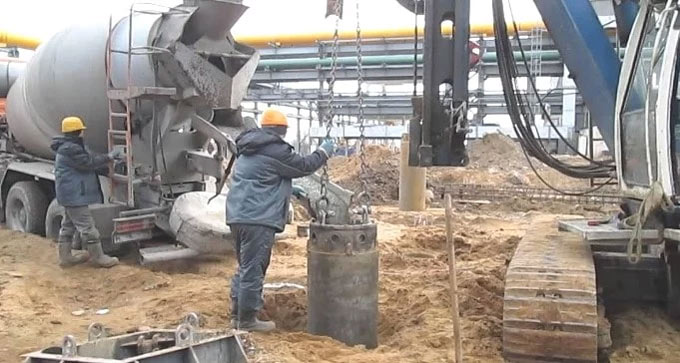
Cast in situ or cast-in-place piles are cast in position inside the ground; generally in such type of piles, drilling of necessary diameter and depth into the ground is done with an auger drilling device or a drill bit.

There is a helical screw blade generally known as a “fighting blade” inside the device that functions as a screw conveyor to eliminate the drilled out material. Besides, auger drilling an old method known as percussion drilling is also applied for excavating the hole. Under this method, a heavy cutting or hammering bit affixed to a roper or cable is lowered in the open hole or inside a temporary casing.

After entering deep into the ground, a temporary steel casing is lowered in the borehole to safeguard loose soil from dropping in the borehole.

The verticality of the casing should be examined precisely prior to start. Once the optimal depth is attained, the reinforcement cage with vertical rebars and stiffeners is lowered within the borehole, and the upper part is hanged at the top. The concreting is generally performed with Tremie method of concrete piling.

There are normally 6 types of cast in situ piles as below:-

1. Simplex Pile, 2. Franki Pile, 3. Vibro Pile, 4. Vibro Expanded Pile, 5. Raymond Pile, 6. Mac Arthur Pedestal Pipe

Benefits of Cast In Situ Concrete Piles: The cast in situ piles are set up with pre-excavation and reduce the vibration because of driving as in case of driven piles.

In housing area, sound pollution may occur if the piles are entered by hammering. To get rid of this issue, situ piling is suitable in such areas.

For water logged area, cast in situ piling with permanent casing is very effective.

The skin friction resistance with the ground is fully used in cast in situ piles throughout the design phases that is not recommended in case of driven piles where only the end bearing is applied.

Normally, there is no need of any foreign materials and tools and the original equipments and materials will meet the requirements of a project, as a result the cast-in-situ piles become as a cost-effective and adjustable type of pile foundation.

Precast piles should be designed to satisfy the handling and driving stresses thus enhancing the essential reinforcement that does not happen in the case of cast in situ piles and therefore, the amount of necessary reinforcement is minimized.

Cast in situ piles are attached over the ground with a pile cap that applies a monolithic approach. The top ground is excavated up to pile cut off level from where the slushy low quality concrete is eliminated with hand hilty to retain developed rebars into the pile cap.

Because of this monolithic connection, cast in situ pile provides good resistance against the earthquake and wind forces.

As soon as the piles are casted, no maintenance is required.

Since the materials and machinery applied are obtained from the local community, local contractors can perform the job and not any skilled labor is required for cast in situ piles.

No serious consideration should be provided for joints in cast in situ piles with regards to precast driven piles.

Details of Cast in Situ Concrete Piles and their advantages

Read more

~~~~~~~~~~~~~~~~~~~~~~~~
Published By
Rajib Dey
www.constructioncost.co
~~~~~~~~~~~~~~~~~~~~~~~~
Monday, August 6, 2018

Mechanical properties of building materials

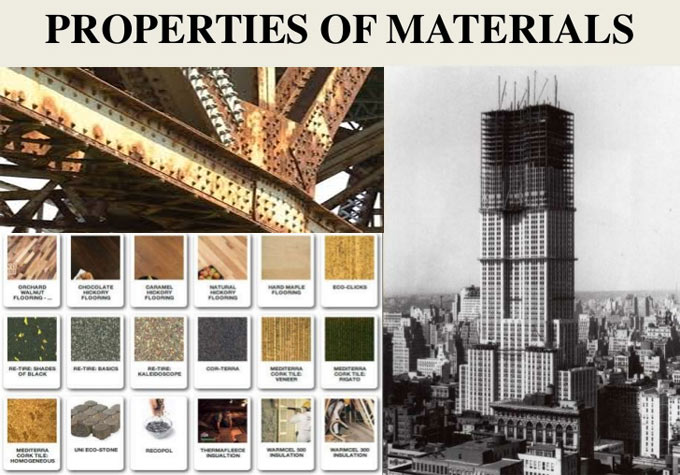
All the building structures are developed with various types of materials. These materials are either known as building materials or materials of construction. The cost of material in a building varies from 30 to 50 percent of entire building cost.

Given below, the detail mechanical properties of materials :-

Strength:

a. Strength is defined as the strength of material to resist the load.
b. Strength of materials – Capacity to resist an applied stress devoid of failure.
c. Compressive strength – Capacity to resist axially directed pushing forces.
d. Tensile strength – Highest stress at the time of being expanded or dragged prior to necking.
e. Shear strength – The capacity to resist shearing.
f. Elasticity – In a material if exterior load is employed it experiences deformation and on elimination of the load, it gets back to it’s actual shape.


Plasticity: If a material fails to retrieve it’s actual shape while eliminating the exterior load, it is defined as plastic materials.

Ductility: When a material experiences a significant deformation devoid of rupture, it is known as ductile materials.

It experiences a large deformation throughout tensile test. It is considered as the most perfect material for tension member. Steel, copper, wrought iron, aluminum alloys belong to ductile materials.

Elongation is in excess of 15%

Brittleness:

a. If a material can’t experience any deformation if some external force functions on it and it collapses with rupture.
b. Brittleness means powerful in compression and poorer in tension.
c. Brittleness is found in C.I, glass, concrete, bricks etc.
d. Elongation remains under 5%


Malleability: Malleability is the capability of a material to distort under pressure (compressive stress). After being malleable, a material is flattened into thin sheets through hammering or rolling. Several metals with high malleability also contain high ductility.

Malleable materials are gold, silver, copper, aluminum, tin, lead steel etc.
Toughness: Toughness means the capability of a material to consume energy prior to rupture is known as toughness.
Toughness is found in mild steel, wrought iron etc.
Hardness: Hardness means the resistance of materials against abrasion, indentation, wear and scratches.
C.I is stronger material.
Stiffness: Stiffness refers to force that is necessary to create unit deformation in a material.
Creep: Creep means inelastic deformation because of sustained load.
Physical properties of materials
Bulk density = ρ = M/V
Water absorption
Permeability
Stability
Specific gravity (G): Mass of solids of specified volume / Mass of equal volume distilled water
Mechanical properties of building materials

~~~~~~~~~~~~~~~~~~~~~~~~
Published By
Rajib Dey
www.constructioncost.co
~~~~~~~~~~~~~~~~~~~~~~~~
Friday, August 3, 2018

Some useful information on detailing of beam

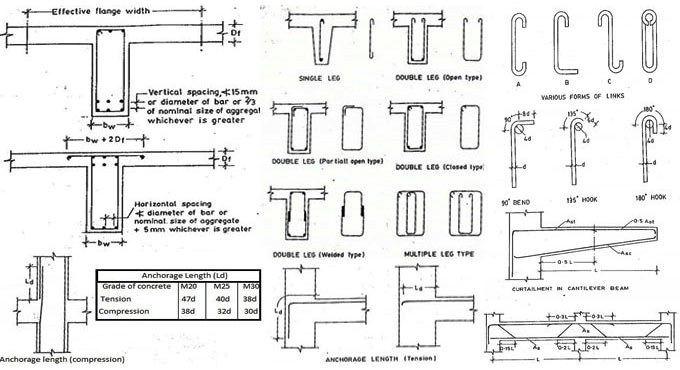
Detailing is one of the most crucial basic features of any construction. The architect should evaluate and place different elements of RCC members with proper care.

Proper detailing of reinforcements with accurate drawings is necessary at the construction site to maintain perfect construction process. Normally, these drawings comprises of a bar bending schedule. The bar bending schedule defines the length and number, location as well as the shape of the bar.

The detailing of beams is normally related to the followings :-

a. Size and number (or spacing) of bars
b. Lap and curtailment (or bending) of bars
c. Development length of bars
d. Clear cover to the reinforcement
e. Spacer and chair bars


The steel that is applied in beams pertains to various categories on the basis of the following objectives :-

i) Longitudinal reinforcement at tension and compression face (at least two 12 mm diameter bar should be arranged in tension) in single or multiple rows should be supplied.

ii) Shear reinforcements in the type of vertical stirrups and or bent up longitudinal bars should be arranged. (The bar bent round the tensile reinforcement and delivered to the compression zone of an RCC beams is known as stirrups).

iii) Side face reinforcement in the web of the beam is placed when the depth of the web in a beam remains in excess of 750 mm. (0.1% of the web area and allocated consistently on two faces at a distance not surpassing 300 mm or web thickness whichever is lower).

Some useful information on detailing of beam


Read more

~~~~~~~~~~~~~~~~~~~~~~~~
Published By
Rajib Dey
www.constructioncost.co
~~~~~~~~~~~~~~~~~~~~~~~~
Thursday, August 2, 2018

How to develop strong brick veneer cavity walls

Brick veneer cavity walls are mostly recognized product which can be used at the exterior of different types of buildings. With its conventional, rugged aesthetic and tested performance, bricks become a perfect choice for commercial, institution, and multifamily residential structures.

While designing, detailing, and constructing a brick wall assembly, considerations should be given on various factors. Given below, some useful tips to maintain moisture control, thermal performance, integrity, and durability of brick walls.

Never skimp on flashing materials within the cavity. Conventional materials like copper, lead-coated copper, stainless steel are very expensive but they are considered as the most long-lasting and trustworthy options.

Plan for thermal expansion/contraction of brick and concrete. Brick assembles frequently integrate brick and concrete components, both of which are extended and compacted at various rates and in diverse conditions. Due to this detailing becomes complicated for horizontal and vertical expansion joints, shelf angles, and modifiable veneer anchors.

Choose the feeble mortar for the job. If the mortar is extremely rigid, adjoining bricks can’t be moved and result in producing cracks and spalls.

Arrange minimum one inch of air space behind brick veneer. This void space operates as the drainage cavity where water is headed downward to the flashing and weeps and out of the brick veneer. If open weeps are utilized, this air space also allows to discharge the cavity, facilitating the interior components to get dried instantly.

Get clear ideas on vapor flow direction, and detail accordingly. For normal buildings, the direction of water vapor flow will differ by season and often on every day, based on the climate.

To get more details, go through the following link www.bdcuniversity.com

How to develop strong brick veneer cavity walls


~~~~~~~~~~~~~~~~~~~~~~~~
Published By
Rajib Dey
www.constructioncost.co
~~~~~~~~~~~~~~~~~~~~~~~~

Tuesday, July 31, 2018

What should be the properties of good RCC?

In this construction video tutorial, you will come to know about the properties of good RCC.
Given below, the details of properties :-
It should have the ability to withstand tensile, compressive, bending and shear forces.
In RCC, there should not be extreme deflection in structural members.
There should be perfect cover for reinforcement.
The materials in RCC should have the good resistance capacity against fire.
In fresh state, RCC should be moulded to any required shape.
The reinforcement that is utilized in concrete should be free from rust and corrosion.
To get more detail information, go through the following video tutorial.
Video Source: F&U-FORYOU

~~~~~~~~~~~~~~~~~~~~~~~~
Published By
Rajib Dey
www.constructioncost.co
~~~~~~~~~~~~~~~~~~~~~~~~
Monday, July 30, 2018

The 7 Major Highway Cross Sectional Elements of a Road

Given below, the details of cross sectional components of a road

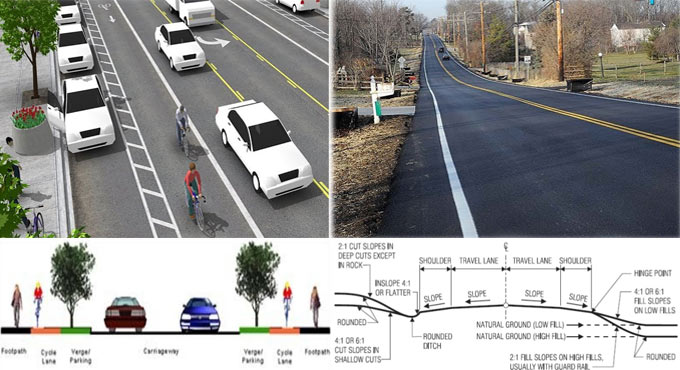
1) Right of way: Right of way or permanent land stands for the area of land obtained and conserved for construction and formation of a road along its alignment. The width of right of way is termed as permanent land width or road land width.

2) Road way / Formation width: The top width of a highway embankment or bottom width of highway cutting exclusive of the side drain is known as roadway width or formation width. It belongs to the sum of width of carriageway and the shoulders.

3) Carriageway: Carriageway or pavement or crust is defined as the segment of roadway developed for movement of vehicular traffic

4) Shoulder: The segments of roadway among the exterior edges of the pavement and edges of the top surface of the embankment or inside edges of the side drains in cutting are termed as shoulders.

The objective of shoulders

i) They offer lateral strength to the carriageway.
ii) They function as parking place for vehicle for emergency purpose.
iii) They arrange space for constructing road signals.
iv) They arrange space for animal drawn vehicles, cyclists, pedestrians.


5) Berm: The segments of land width kept among the toe of road embankment and the inner edges of borrow pits or the segments amid the top edges of road in cutting and the adjacent edges of spoil banks on either side are described as berm.

6) Building Line: It refers to the line, on either side of the road, among which and the road; no building activity can be done at all.

7) Control Line: It refers to the line which shows the nearby restraint of future unrestrained building activity concerning a road. It implies that though building activity is not entirely combined among the building line and control line, the nature of building allowable here is restricted.

The 7 Major Highway Cross Sectional Elements of a Road

Read more

~~~~~~~~~~~~~~~~~~~~~~~~
Published By
Rajib Dey
www.constructioncost.co
~~~~~~~~~~~~~~~~~~~~~~~~
Tuesday, July 10, 2018

Bridge pile cap construction details

This construction video is based on pile cap construction process for building up a bridge. The video is specifically designed for bridge engineer.

The video throws light on the following topics :-

a. Pile Head Breaking
b. Granular laying
c. CC work
d. Rebar Fabrication


The construction method of bridge is segregated into two parts :-

Substructure (pile foundation, pile cap, pier, pier cap)

Superstructure (bearing, girder, slab)

Definition of pile cap: It belongs to a structural member that is positioned and generally attached on the top of a pile or a group of pier to transfer the loads into the pile or group of piles to relate them into a bent.

Functions of pile cap
To disperse a single load evenly over the pile group as well as over a larger area of bearing potential.


To laterally strengthen separate piles and enhance complete durability of the group.
To arrange the required combined resistance to stress organized by the super structure and ground movement.
To transfer the loads of the building to the foundations and the ground soil layers despite the loads are vertical or inclined.
To facilitate the column or superstructure to stay on a consistent and solid core foundation rather than staying directly on ground.


To learn the detail pile cap construction process for a bridge, go through the following video tutorial.

Video SourceConstruction Methodology

~~~~~~~~~~~~~~~~~~~~~~~~
Published By
Rajib Dey
www.constructioncost.co
~~~~~~~~~~~~~~~~~~~~~~~~

Wednesday, June 14, 2017

Different types of doors for building

The size of the door should be made with such dimension so that it becomes possible to move the largest object through the doors.
For residential buildings, the size of the door should start from 0.9 m × 2.0 m and over. Larger doors are built up at the core entrance to the building to make view elegant. Minimum sized doors are suitable for bath rooms and water closets. The proposed size is 0.75 m × 1.9 m. As a thumb rule height of door should have been 1 m over and above its width.
Types of Doors - Different types of doors are available which are categorized based on the disposition of shutters, construction processes, precepts of working operations and materials employed. Detailed information is given below for the doors which are frequently used in the buildings:
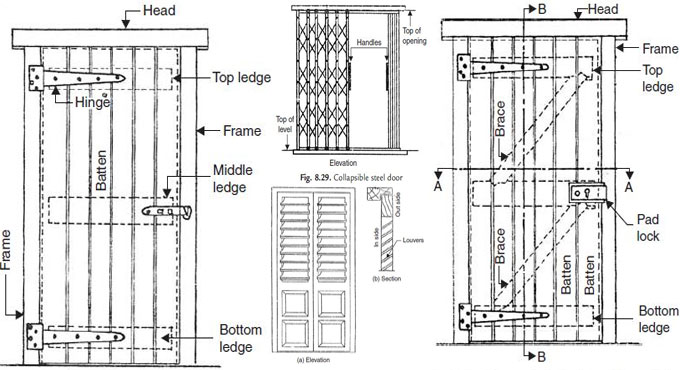
1. Battened and Ledged Doors: Battens are 100 mm to 150 mm large and made with 20 mm dense wooden boards. Their length is that of door opening. The battens are tied with horizontal planks, which are called as ledges of size 100 to 200 mm large and 30 mm thick. Generally, three ledges are employed one at top, one at bottom and the third one at mid-height. This is the easiest form of door and the economical also. Battens are fastened with tongued and grooved joint.
2. Battened, Ledged and Braced Doors: If doors are wide except for applying battens and ledges diagonal members, identified as braces, are used to make the door toughen.
Periodically, above two types of shutters are supplied inside wooden frame work and in those cases they are named as battened, ledges and framed doors.
3. Framed and Panelled Doors: This type of door comprises of vertical members, known as styles and horizontal members known as rails. The styles and rails are properly grooved to obtain panels. The panels may range from wood, A.C. sheet, glasses etc. The panels are flat or of raised type for having good appearance. These doors are used extensively. They are made of single shutter or of double shutter. If glass panels are employed they are known as glazed doors.
To get more information, go through the following link civilengineeringx.com
Different types of doors for building

~~~~~~~~~~~~~~~~~~~~~~~~
Published By
Rajib Dey
www.constructioncost.co
~~~~~~~~~~~~~~~~~~~~~~~
~

Friday, March 31, 2017

What should be the qualities of a qualified civil engineers

1. TESTS OF BUILDING MATERIALS:
A qualified civil engineer should be well familiar with various tests of building materials. Given below, detailed lists of some vital tests.
 Concrete Test: Slump test, compression test, split tensile test, soundness etc.
 Soil Test: Core cutter test, compaction test, sand replacement test, triaxial test, consolidation test etc.
 Bitumen Test: Ductility test, softening point test, gravity test, penetration test etc.
2. Examination OF SOIL:
Prior to develop a construction, different types of soil tests are done for finding out the settlement and strength of soils before starting a construction. Therefore, a civil engineer must contain sound knowledge regarding these tests which are carried out at the jobsite.
3. Application OF SURVEYING Tools:
A civil engineer should be well versed with utilizing various surveying instruments like the total station, theodolite etc. These instruments can be applied for marking and perfect measurements.
4. STANDARD CODES utilized IN CONSTRUCTION:
Each country contains their own standard safety specifications (eg: Is Code) for performing various activities associated with construction. There are various types of rules and methods in the standard codes and these are followed to build up new construction. If not, there are risks factors for collapsing of a structure.
5. BAR BENDING SCHEDULE:
Bar bending schedule is considered as a crucial chart for civil engineers. It helps to make the reinforcement calculation for RC beam that ranges from cutting length, type of bending, the length of bending etc.
6. DRAWING AND DESIGN:
Drawing and design are considered as the pillars of a project in-progress. It offers all the necessary specifications of that project. Each site engineers must have the capability to efficiently analyze such drawings and designs.
7. ESTIMATION AND BILLS:
A civil engineer should be able to prepare estimation and bills toward a construction project.
8. QUALITY CONTROL:
Quality control maintains the profit of a project by lessening the additional costs. Therefore, a civil engineer should contain the fundamental knowledge of quality control.
9. ON FIELD MANAGEMENT:
A civil engineer should have clear ideas on form-work, concreting, safety measures etc.
10. COORDINATION WITH LABOR:
A civil engineer should have the capability to manage labors efficiently in a jobsite.
What should be the qualities of a qualified civil engineers
~~~~~~~~~~~~~~~~~~~~~~~~
Published By
Rajib Dey
www.constructioncost.co
~~~~~~~~~~~~~~~~~~~~~~~~

Saturday, January 7, 2017

The reason behind the usage of reinforcement in concrete

Rebar which is also addressed as reinforcing bar is a key element of reinforced concrete. It is typically structured from ridged carbon steel; the ridges give frictional adhesion to the concrete. Rebar is used for the reason that even though concrete is very tough in compression it is in effect without strength in tension.

One of the most extensively used modern building materials is reinforced concrete. Concrete is defined as an “artificial stone” achieved by mixing cement, sand, and aggregates with water. Fresh concrete can take any kind of shape, giving it an intrinsic benefit over other materials.

The reinforcement in concrete possibly will be simple bar or series of bars, bend to a given schedule which known as bar schedule and tied in accordance with the reinforcement drawings with stirrups.

Watch the full demonstration about usage of reinforcement in concrete.

Don’t forget to subscribe and share this channel and get connected. Enjoy and share with your friends, colleagues who are associated with civil engineering sector.


~~~~~~~~~~~~~~~~~~~~
Published By
Rajib Dey
~~~~~~~~~~~~~~~~~~~~

Tuesday, October 18, 2016

Construction Materials & Quality Control in construction site for Civil Engineering

Countless types of Building materials are used in the construction industry to create buildings and structures. These groupings of materials and products are used by architects and construction project managers to state the materials and techniques used for building projects.

BTech Engineering has presented an useful information which will assist engineers in construction worksite for determining the quality of construction materials. Construction Materials and Quality Control that used in construction of buildings like First class bricks quality, properties of sand, cements quality much more materials aggregates, stones, steel and so on.

Study the following video attentively:

~~~~~~~~~~~~~~~~~~~~~
Published By
Rajib Dey
~~~~~~~~~~~~~~~~~~~~~

Monday, April 4, 2016

How to set up stone veneer to the exterior of your home to give it an elegant look

Rae Young briefly shows through this youtube construction video to set up Stone Veneer in exterior of your home to give an elegant look.

Stone veneer is a useful construction material to be applied as a preventive and fancy covering for outward or inward vertical walls and surfaces. The veneer is generally 1 inch thick and its weight should be below 15 pounds per square foot (73 kg/m2)in order to avoid any extra structural supports.

Stone veneer is built with natural stone and manufactured stone.

Natural stone veneer is developed with real stone that belongs to either collected, i.e. fieldstone, or quarried. The stone is sliced to a uniform thickness and weighted to be applied as a veneer. This stone is usually known as thin stone veneer.

Manufactured stone veneer refers to an attractive building material built to reproduce the look of natural stone. Various types of artificial stones, faux stone, stacked stone veneer, manufactured stone, and flexible stone veneer are also utilized for manufactured stone veneer.

Manufactured Stone veneer is formed by pouring a lightweight concrete mix into rubber forms having various styles. It is then colored to make it real stone. Then the produced stone veneer is added to walls through special mortars.

Flexible stone veneer is produced by dragging a thin layer of stone out of a slab of slate, sandstone, or mica schist. It is supported with a blended material.


~~~~~~~~~~~~~~~~~~~~~
Published By
Rajib Dey
~~~~~~~~~~~~~~~~~~~~~