adsense analytic

Showing posts with label reinforcement design. Show all posts

Friday, June 3, 2016

Specification Of Concrete Cover For Concrete Slab Design

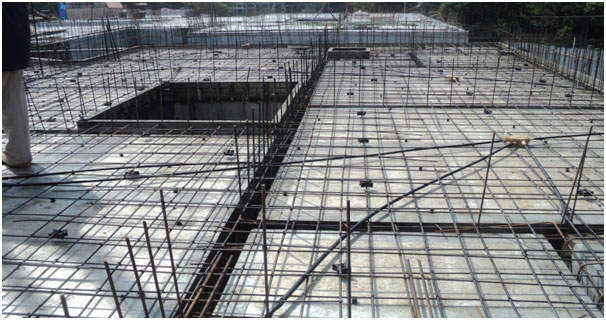
Concrete cover for reinforcement is essential for safeguarding the rebar against erosion as well as fire. The depth of the cover is based on ecological conditions and type of structural member. The slightest thickness of reinforcement cover is specified in the drawings, or achieved from the related code of practice. The specifications for reinforcement cover for various structural members in diverse conditions are explained below :-

a) To each end of reinforcing bar, not below 25 mm or below twice the diameter of the bar.

b) In case of a longitudinal reinforcing bar in a column, not under 40 mm not less than the diameter of such bar. For columns of least dimension of 20 cm or below, whose reinforcing bards should not surpass 12 mm, a cover of 25 mm should be applied.

c) For longitudinal reinforcing bars in a beam, not under 30 mm or below the diameter of the bar.

d) For tensile, compressive shear or other reinforcements in a slab or wall not below 15 mm, not less than the diameter of such bar.

e) For any other reinforcement not below 15 mm, not less than the diameter of such bar.

f) For footings and other major structural members in which the concrete is placed directly alongside the ground, cover to the bottom reinforcement must be 75 mm. If concrete is discharged on a layer of thin concrete, the bottom cover is curtailed to 50 mm.

g) For concrete surfaces uncovered to the weather or the ground once forms are separated - like retaining walls, grade beams, footing sides and top etc. below 50 mm.

h) Expanded cover thickness is offered as specified on the drawings, for surfaces uncovered to the action of injurious chemicals (or uncovered to earth polluted by such chemicals), acid, alkali, saline atmosphere, sulphorone, smoke etc.

For more information, visit this link.
Specification of Concrete Cover for Concrete Slab Design

~~~~~~~~~~~~~~~~~~~~~
Published By
Rajib Dey
~~~~~~~~~~~~~~~~~~~~~

Saturday, May 7, 2016

Categories And Design Of RCC Slabs And RCC Structures

Reinforced Cement Concrete Slab

  • A Reinforced Concrete Slab Component plays a vital role in a building. It is considered as a useful structural element of the current buildings. There are various columns and beams which provide support to Columns and Beams.
  • The density of RCC Slabs varies from 10 to 50 centimetres which are generally found in developing floors and ceilings.
  • Thin concrete slabs are also utilized for the objective of exterior paving.
  • In several domestic and industrial buildings, a solid concrete slab, sustained on foundations or directly on the sub soil, is utilized to develop the ground floor of a building.
  • Thinner, pre-cast concrete slabs are pushed among the steel frames of tall buildings and skyscrapers to construct the floors and ceilings on each level.
  • At the time of creating structural drawings of the reinforced concrete slab, the slabs are shortened to “r.c.slab” or simply “r.c.”.


Design of various types of slabs and their reinforcement

There are lot of designs available for a suspended slab to develop the strength-to-weight ratio. In most cases the top surface stands flat, and the bottom is modulated:


  • If the concrete is poured into a corrugated steel tray, generally it is called corrugated. It enhances the strength and avoids the bending of slab under its own weight. The corrugations happen on the short dimension, from side to side.
  • A ribbed slab provides significant additional strength on one direction.
  • A one way slab contains structural strength in shortest direction whereas a two way slab contains structural strength in two directions.

These slabs belong to cantilevered or Simply Supported Slabs.


Categories and Design of RCC Slabs and RCC Structures

~~~~~~~~~~~~~~~~~~~~~
Published By
Rajib Dey
~~~~~~~~~~~~~~~~~~~~~
Friday, May 6, 2016

GRIDFORM™ Is An Advanced Concrete Reinforcing System For Vehicular Bridge Decks

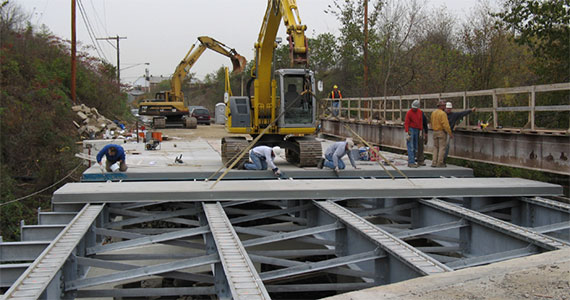
GRIDFORM™ refers to a superior concrete-reinforcing system supported with prefabricated fiber reinforced polymer (FRP) double-layer grating and fundamental stay-in-place (SIP) form specifically designed for vehicular bridge decks.
This reinforcement system comprises of FRP plates glued to the bottom grating of FRP double-layer grating panels which produce a bidirectional, lightweight panel of the grid construction to be used with corrosion-free concrete bridge decks.
The lightweight GRIDFORM™ panel measures only 4.7 pounds per square foot. It is fabricated in shop with very big units which are restricted only by shipping constraints to around 50 ft. by 8 ft.
In the jobsite, the GRIDFORM™ is elevated through a single pick of a crane and directly set in the girders of the bridge. The GRIDFORM™ panel is pre-engineered and completed so that it can be affixed quickly to the bridge girders and relevant concrete placement and forming. The GRIDFORM™ bridge deck lasts long as compared to the steel reinforced concrete bridge decks as FRP delivers a corrosion-free reinforcement system for the concrete.
GRIDFORM™ Design Guide
The GRIDFORM™ Design Guide offers proper guidelines to structural engineers to define if GRIDFORM™ can be substituted for steel rebar as the internal reinforcement system for reinforced concrete bridge decks. Any engineering firm or installation contractor can utilize GRIDFORM™ by adhering to Strongwell's Terms and Conditions.
The GRIDFORM™ Design Guide is based on Microsoft® Excel® version 2003 or 2007.
GRIDFORM™ Is An Advanced Concrete Reinforcing System For Vehicular Bridge Decks
~~~~~~~~~~~~~~~~~~~~~
Published By
Rajib Dey
~~~~~~~~~~~~~~~~~~~~~