adsense analytic

Wednesday, December 18, 2019

Types of Cranes Used in the Construction Industry

From as far back as the Mesopotamian civilization, cranes have been used for lifting objects that are too heavy or too repetitive to be done manually. Since this type of work is very much used in the construction industry, the use of cranes in it has been invaluable and indispensable since the ancient era. From the ancient Shadouf to roman Polyspastos to modern mobile telescopic cranes, they were used pretty much everywhere on earth.

What is a Crane?

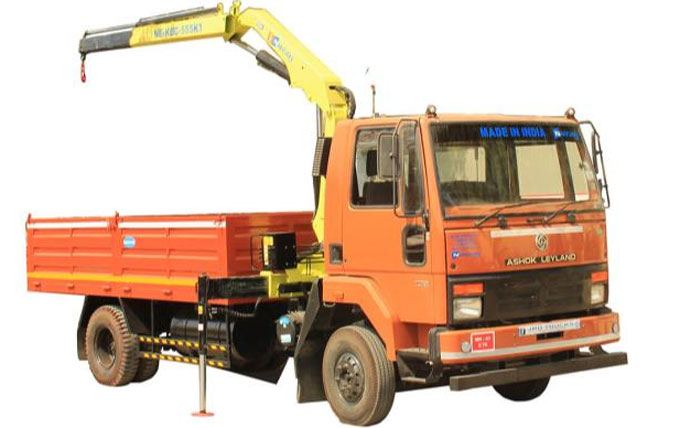
A crane is a machine, comprised of beams, cables, and pullies, which is used to lift or lower heavy objects. An appropriately equipped crane may also move objects horizontally as well as vertically. The mechanism can be supported by a tower or a derrick.

Most cranes used in construction are temporary structures or even mounted on mobile platforms so that they can be moved around the construction site as necessary. They can be taken away when construction finishes in order to leave the site for normal usage. In some cases, where the building in question requires constant maintenance, the engineers may choose to rig a permanent crane with the building.

Modern cranes are powered by means of hydraulics that are driven by an electric motor or a combustion engine driven by fossil fuel. Operating (and driving, in case of mobile cranes) the crane is possible from an operators cabin that may be mounted on crane vehicle or rig itself, or a control station beside the crane, or by means of portable radio-operated controllers that gives the crane operator the freedom to move around and see the loading and unloading operation from any reasonable point of view. Taking that flexibility to a newer level, there are some modern cranes available that can even be controlled via mobile phone apps.

Types of Cranes in Building

Depending upon their usage, flexibility, and mobility, there can be several types of cranes to choose from to use in a construction site. The varieties of choices enable the constructor to adapt to any load-lifting requirements on site. Let us see what they are.

Read more
November 2019 Brings Eight Top Construction Projects in US
~~~~~~~~~~~~~~~~~~~~~~~~~~
Published By
Rajib Dey
www.constructioncost.co
~~~~~~~~~~~~~~~~~~~~~~~~~~

Tuesday, December 17, 2019

November 2019 Brings Eight Top Construction Projects in US

This winter is snowing new building projects all over the US of A. From small houses and shops to major residential, offices, and retail we are seeing a lot of developments starting in the last couple of months. Especially, the last month, November 2019, has seen the start of a few major and important building projects.
We will highlight eight of the most important such projects today. These large projects are not only creating a lot of jobs, but also they are by their very nature can influence the market greatly. Their large volume and the need for sustainable enterprises mean they can and do seriously sway the total dollar and square footage volumes. Not to mention the amount of supporting industries that are required to make the project come about will see a major uptick for each of these projects.
Let us move on to the list of the most important 8 American construction projects starting in late 2019 without further ado.
1. Bankside Development Phase 1
On 21st November 2019, Brookfield Properties announced their opening of a mixed-use construction project along the waterfront in the South Bronx’s Mott Haven neighborhood. The project, named Bankside Development, is construed to be built in two phases, and this is the first phase only.
Spreading over the expensive 4.3-acre New York site, the project is designed to provide 1350 apartments. Though the area is for the higher-income parties, 30% of the total residentials will be under the Affordable New York program targeted for the lower-income bands. The apartments will have a permanently unobstructed view of the Manhattan area.
Divisionally located at 2401 Third Avenue and 101 Lincoln Avenue, the project is expected to end by late 2021. Hill West Architect designed seven towers in the project interconnected by low-rise elements. A new public waterfront park of more than 34000 sqft will frame the entire complex on the Harlem river shoreline, seeking to create a naturalized landscape with varieties of custom seating and an abundance of greenery.
November 2019 Brings Eight Top Construction Projects in US
~~~~~~~~~~~~~~~~~~~~~~~~~~
Published By
Rajib Dey
www.constructioncost.co
~~~~~~~~~~~~~~~~~~~~~~~~~~
Friday, December 13, 2019

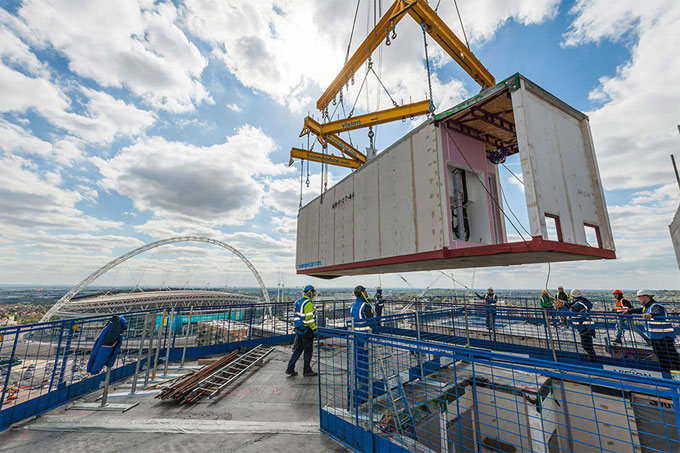
Five Reasons Why Off-site Modular Construction is the New Favorite

What is Off-site Modular Construction
Up until the last decade, we have always known construction business is to be conducted on project site. However, with the advent of technology, a new method of building has come up. This is called Off-site Modular Construction, and it is shaking the construction industry at the roots.
In this process, portions of a building are constructed in remote factories or fields that are specifically set up for that purpose. They are built using the same design and materials - but since they are being built in a factory for that express purpose, the construction takes about half the time. These “modules” are then carried off to the project site and are assembled there to reflect the original design of the entire project.
Growth in Modular Construction Business
There has been an increased demand for off-site modular construction, ever since the construction industry has rebounded up since 2013. Experts project that the market has progressed by 26% between 2014 to 2017.
An estimate is that the projected growth for the period 2018 to 2020 is by 4% every year. Such promising verticals can be associated with the resurgence in sectors such as education, offices, and retail. It is also a gift from with increased market for locality accommodation on infrastructure projects.
Architects, developers, and constructors are all gradually becoming aware of the plethora of benefits offered by technological innovations associated with the modular construction industry. From hotels, retail, offices, public buildings, apartment blocs to simple homes - all sorts of construction projects can be assembled with offsite modular structures.
This method of building is a favorable alternative to regular on-site construction, and it is durable and cost-effective. The main reason for that is the offsite modular building offers great quality and flexibility. It is also faster to finish the project with fewer expenses. Also, when it comes to counting the environmental impact and guaranteeing sustainability, there is no match for off-site construction methods.
Five Reasons Why Off-site Modular Construction is the New Favorite

~~~~~~~~~~~~~~~~~~~~~~~~~~
Published By
Rajib Dey
www.constructioncost.co
~~~~~~~~~~~~~~~~~~~~~~~~~~
The Future of Construction with Robots

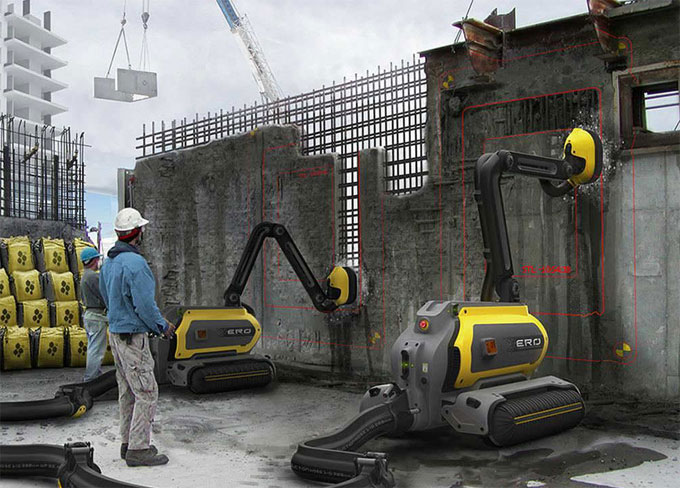
Robots make everything better, don’t they? Sure they do. The engineers and architects related to the construction industry think so as well. Construct-o-bots (or similar) have existed in science fiction forever. However, construction and architecture have been the least automated industries until recently. The nature of the work required to build a structure has always required a human mind to drive it, and the sheer number of steps to construct a simple thing and the varieties of tasks to be undertaken for a building translates into doing it manually. Over time, we have started to use machines for each step or task that can be automated or had to be mechanized, for example, concrete mixing, or pumping it far away. But to actually use Artificial Intelligence to make a simple wall has been impossible due to its intricacies. Well, up until now.
It is not like that construction work does not have scope for robotics and automation in it. On the contrary, there are plenty of jobs in a building site that are repetitive but not complex. Also, there are many occasions in a building site where humans would be in great danger. However manual labor has always been plentiful and heavy robotics hasn’t been making much headway until the last decade.
But we have come far indeed. From using pullies and mixing drums, we are now using cranes and dozers operated by joysticks or even by remote. New technologies are opening up new doors in modern constructions. Only in the last decade, we have seen various prototypes like robots to carry stuff, drones to survey, autonomous vehicles for transport, 3D printing for modeling, exoskeletons to augment worker strength and much more. Recently shortages of manual labor and low unemployment in the country are driving modern constructors to consider more mechanized solutions than ever.
Many tasks in construction can be taken care of by robots, including bricklaying, painting, loading, carrying, and bulldozing. In fact, in the transportation field, there are already many AGV’s (Automated Guided Vehicles) and AMR’s (Autonomous Mobile Robots) hard at work, and we can expect to see their numbers multiply significantly in a short while. There are three key factors that are driving the need for more robots in the construction industry. One, that robots can protect or replace human workers in a hazardous work environment. Secondly, increased usage of robots will decrease workplace injuries drastically. Not to mention that a gap in the manpower left by labor shortage can be filled by work bots.
There are already some incredible examples of machines driven by set data taking over large portions in the building sites. Today let us look at a few of some awesome examples of using robots in construction.
The Future of Construction with Robots


~~~~~~~~~~~~~~~~~~~~~~~~
Published By
Rajib Dey
www.constructioncost.co
~~~~~~~~~~~~~~~~~~~~~~~~

Thursday, December 12, 2019

Concrete Sweating: What is it and How to Prevent it

Concrete is used for all kinds of construction works these days. It is the first choice for building supports and beams because of its excellent load-bearing capacity, tensile strength, and longevity. However, nothing is a hundred percent impervious to weather effects, and neither is concrete.
Concrete Sweating, or more technically known as SSS (Sweating Slab Syndrome) occurs when water droplets are accumulated on the surface of a concrete structure. The phenomena occur generally overnight and may look like the concrete structure is sweating, hence the name. This can be a potentially dangerous issue in some cases.

Reasons for Concrete Sweating

There can be two main reasons why a structure is showing the SSS - dew point and subsurface moisture. Let us discuss them below.

Dew Point

When you take a soda out of the fridge and keep it out for a while, the soda bottle or can starts sweating. The same thing happens with concrete as well, especially overnight. A concrete surface is rather cooler than the air in contact with it. When the concrete is cooler than the dew point (the temperature at which the water vapor in the air starts to condense into liquid), the moisture in air sticks to the concrete. This, in turn, starts forming the water droplets. Which, to uninformed eyes, looks like as if the concrete has started sweating.

Subsurface Moisture

A much rarer phenomenon, this occurs when the concrete itself retains some moisture inside it. When the concrete is formed, much water is used to set the cement. All that water gets absorbed to form the crystals that harden the concrete. But the issue is, this process can go on for a long time. Initially, most types of cement can set in a day, but they harden over a long time - over weeks, even months. While the composite is hardening, the hydrostatic pressure inside them rises a lot. This, in turn, pushes the water out of the concrete slabs or structures. In this case, you can say that the concrete really does sweat, in view that the water comes from inside, not outside.
There can be some secondary reasons for SSS. For example, if the concrete slab is adjacent to wetness (wet soil or water body), the capillaries in a porous concrete can suck up moisture from the wet surface to the dry surface. Also, if the concrete mix has salts in it then due to their hygroscopic nature the salts will attract water into the concrete. The material on top of the concrete can also be the culprit in attracting water, like dust or rubber.
Concrete Sweating: What is it and How to Prevent it
~~~~~~~~~~~~~~~~~~~~~~~~
Published By
Rajib Dey
www.constructioncost.co
~~~~~~~~~~~~~~~~~~~~~~~~

Monday, December 9, 2019

What is Portland Cement and How is it Used in Construction

What is Portland Cement
The Portland Cement is a particular type of cementing material used in building construction. It is essentially an amalgamation of clay and chalk. This blend, when subjected to water, hardens up and when it is hard, mimics the portland stone in color. The Portland Stone is found in quarries in Portland, Dorset in England initially. This type of hydraulic cement was patented in 1824.
The portland cement is exceptional in giving strength to structural properties. Most commonly, it is used in making concrete. However, the portland cement can also be directly used in creating stucco or be used as a mortar. Some non-specialty grout also uses this type of cement as one of the main ingredients.
ASTM 150 defines the Portland Cement as “hydraulic cement (cement that not only hardens by reacting with water but also forms a water-resistant product) produced by pulverizing clinkers which consist essentially of hydraulic calcium silicates, usually containing one or more of the forms of calcium sulfate as an inter ground addition.”
How is Portland Cement Made
Usually created from heating limestone and clay minerals in a kiln, portland cement needs a little bit of gypsum in it to give it the desired setting qualities and to prevent flash setting. The chemical constituents of portland cement and their ratio are as follows:
1. Calcium oxide (61-67%)
2. Silicon dioxide (19-23%)
3. Aluminum oxide (2.5–6%)
4. Ferric oxide (0–6%)
5. Sulfur oxide (1.5–4.5%)
6. Gypsum (2-10%)
The Mix is generally a thin, light powder. Depending upon the ratio of materials in the clinker and the cement, this powder can be gray, white or something in-between. The most common form, called the OPC, displays a soft gray color. After hardening, it resembles the portland stones found in Dorset.
What is Portland Cement and How is it Used in Construction
~~~~~~~~~~~~~~~~~~~~~~~~
Published By
Rajib Dey
www.constructioncost.co
~~~~~~~~~~~~~~~~~~~~~~~~

Tuesday, October 15, 2019

How to analyze rate for brick masonry work

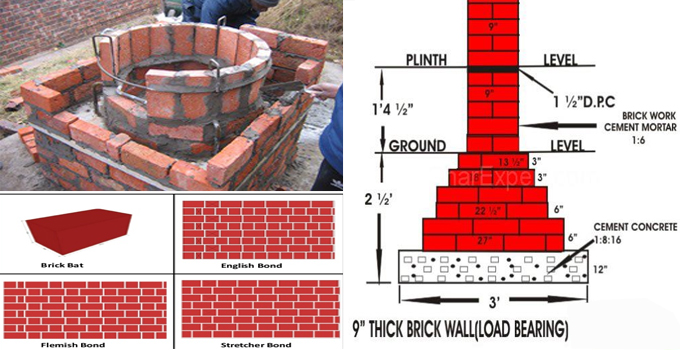
While analyzing the rate of brickwork, it is essential to ascertain the quantities of materials (bricks and mortar) and labors. There are different types of ratios for mortar which range from 1:2, 1:4, 1:6, 1:8 etc. Go through the following like to determine the quantity of mortar.
Estimating the quantity of bricks is necessary for the rate analysis.
Quantity Estimation for Brick Masonry - To analyze the rate of brick masonry, 1m3 of brick masonry is taken:
1. Number of bricks for 1 cubic meter of brick masonry:
For 1m3 of brick masonry, the number of typical size of bricks must be 494.
2. Quantity of mortar for 1m3 of brick masonry:
For 1m3 of brickwork, the quantity of the mortar should be 25 – 30%, i.e. 0.25m3 – 0.3m3 of cement masonry. For this purpose, cement mortar is selected as 0.3m3 .
Labor Estimation for Brick Masonry:
Labors which are essential for brick masonry belong to mason for brick work, labours for transmitting materials (sand, cement, bricks, and water), mixing and transporting mortar.
The quantity of labor is provided as requirement of labour in longer period for 1m3 of brick masonry.
1. Mason: The quantity of mason necessary for 1m3 of brickwork is provided as 0.94 days.
2. Labor: The quantity of labor for different types of works like carriage of materials, blending of mortar, carrying of mortar etc. are amassed. The labour necessary for 1m3 of brick masonry is for 1.57 days.
How to analyze rate for brick masonry work
~~~~~~~~~~~~~~~~~~~~~~~~~~
Published By
Rajib Dey
www.constructioncost.co
~~~~~~~~~~~~~~~~~~~~~~~~~~