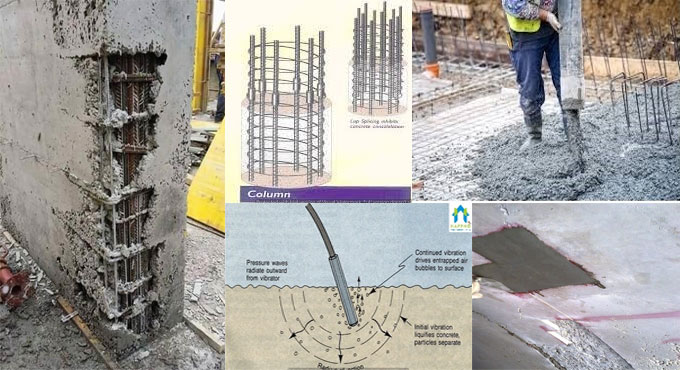
Definition of a honeycombing: Honeycombing refers to a structural fault in a RCC Structure. Honeycombed surface is the areas of the concrete surface where the coarse aggregate are eminently observable.
If precaution is not taken for honeycombed surface, the RCC structure fails to achieve optimal performance according to its design (structurally weak). Besides, it also lets damaging agents like contaminated water and air entering through the produced voids which can impact the strength of structure considerably.
Causes for Honeycombing: Honeycombing in RCC Structure is happened because of the following reasons -
1. Concrete mix is not homogenous.
2. The applicability of concrete is inadequate and not matched with its placement need.
3. Inadequate compaction to concrete.
4. Concrete flow is not dispersed to all corner due to steel congestion.
2. The applicability of concrete is inadequate and not matched with its placement need.
3. Inadequate compaction to concrete.
4. Concrete flow is not dispersed to all corner due to steel congestion.
5. Concrete is set afore time prior to placing.
6. High free fall of concrete, at the time of pouring
7. Form work is not waterproof or inflexible.
8. Incorrect detailing and/or fixing of steel
6. High free fall of concrete, at the time of pouring
7. Form work is not waterproof or inflexible.
8. Incorrect detailing and/or fixing of steel
How Honeycombing in Concrete can be avoided?
Check concrete production/cohesiveness from time to time to organize all concrete batches.
Tip: If it is possible to create ?ball? from the fresh concrete, a cohesive concrete mix is produced.
Concrete workability should tally with the placement need. As for example, a lightly reinforced column should contain 75mm slump, a heavily reinforced column may require 150mm slump.
Make sure that the compaction of placed concrete is perfect, vibrators should have been detached as big air bubbles stops to come out (over vibration can lead to bleeding). Various sizes (25mm, 40mm, and 60mm) of vibrator needle should have been utilized according to RCC sections.
~~~~~~~~~~~~~~~~~~~~~~~~~~
Published By
Rajib Dey
www.constructioncost.co
~~~~~~~~~~~~~~~~~~~~~~~~~~
Published By
Rajib Dey
www.constructioncost.co
~~~~~~~~~~~~~~~~~~~~~~~~~~
