adsense analytic

Showing posts with label form work. Show all posts

Friday, February 7, 2020

How to avoid Honeycombing in RCC Structures

Definition of a honeycombing: Honeycombing refers to a structural fault in a RCC Structure. Honeycombed surface is the areas of the concrete surface where the coarse aggregate are eminently observable.
If precaution is not taken for honeycombed surface, the RCC structure fails to achieve optimal performance according to its design (structurally weak). Besides, it also lets damaging agents like contaminated water and air entering through the produced voids which can impact the strength of structure considerably.
Causes for Honeycombing: Honeycombing in RCC Structure is happened because of the following reasons -
1. Concrete mix is not homogenous.
2. The applicability of concrete is inadequate and not matched with its placement need.
3. Inadequate compaction to concrete.
4. Concrete flow is not dispersed to all corner due to steel congestion.
5. Concrete is set afore time prior to placing.
6. High free fall of concrete, at the time of pouring
7. Form work is not waterproof or inflexible.
8. Incorrect detailing and/or fixing of steel
How Honeycombing in Concrete can be avoided?
Check concrete production/cohesiveness from time to time to organize all concrete batches.
Tip: If it is possible to create ?ball? from the fresh concrete, a cohesive concrete mix is produced.
Concrete workability should tally with the placement need. As for example, a lightly reinforced column should contain 75mm slump, a heavily reinforced column may require 150mm slump.
Make sure that the compaction of placed concrete is perfect, vibrators should have been detached as big air bubbles stops to come out (over vibration can lead to bleeding). Various sizes (25mm, 40mm, and 60mm) of vibrator needle should have been utilized according to RCC sections.
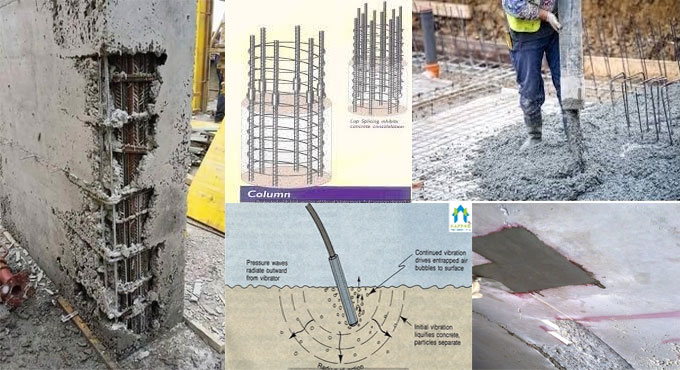
How to avoid Honeycombing In RCC Structures
~~~~~~~~~~~~~~~~~~~~~~~~~~
Published By
Rajib Dey
www.constructioncost.co
~~~~~~~~~~~~~~~~~~~~~~~~~~

Monday, March 25, 2019

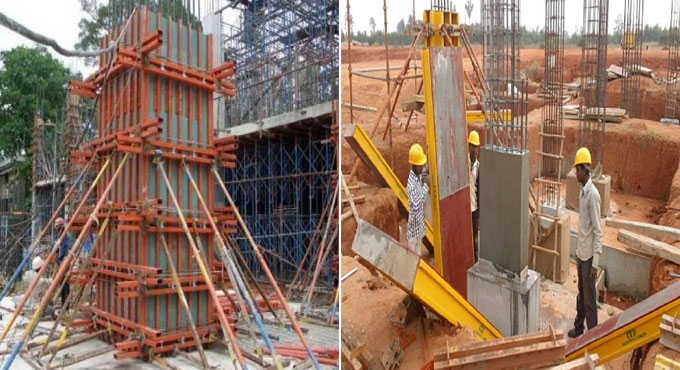
Some useful tips to examine concrete formwork in job site

The finalized inspection of concrete formwork should be examined prior to set the reinforcement bars in exact location. By implementing perfect form work, honey combing, blow holes, grout less or discoloration of concrete can be circumvented and consequently the finished surface of concrete becomes superior.

Prior to commencement of concreting work, shuttering surface should be fully cleansed and does not contain any defect/deposits in order to provide rightly straight smooth concrete surface. Shuttering surface does not contain any damage and unnecessary roughness to its surface.

While building concrete form work, the following should be examined properly.

1. Any member to be retained in position once the general dismantling is completed, should be labeled perfectly.
2. The applicable materials should be thoroughly examined in order that no incorrect items/rejects are utilized.
3. When excavations exist nearby reformatory and strengthening action should be undertaken to impact the safety of form work.
4. The quality of bearing soil should be strong and it should be arranged properly and the sole plates should bear well on the ground. Sole plates should be perfectly placed on their bearing pads or sleepers. The bearing plates of steel props should not be deformed. There should be adequate bearing areas for the steel sections on the bearing members.

5. There should be proper safety provisions to get rid of impact of traffic, scour caused by water and accidental impacts.
6. To maintain proper strength and durability of form work at intermediate stage, bracing, struts and ties should be provided together with the advancement of form work. Avoid ‘Tilting and overturning of steel sections.
7. While applying customizable steel props, no damage and evident bents should be observed; steel pins should be arranged, restricted latterly near each end.
8. Screw adjustments of adaptable props should not be over extended.

9. When settlement/elastic shortening of props happens, double wedges should be arranged for correction of the form to the desired position. Wedges are applied only at bottom end of single prop and should not be very steep and one of the pair should be secured/clamped down after correction to avoid their shifting.
10. No member should be eccentric over vertical member.
11. There should sufficient number of bolts and nuts and cantilever supports.
12. Props shall remain directly under one another in multistage construction.
13. Guy ropes or stays should be perfectly tensioned.
14. Provision should be arranged for movement and operation of vibrator and other plant and equipment.
15. Required camber should be arranged over long spans.
16. Supports shall be sufficient and in plumb.


Some useful tips to examine concrete formwork in job site

Read more
~~~~~~~~~~~~~~~~~~~~~~~~
Published By
Rajib Dey
www.constructioncost.co
~~~~~~~~~~~~~~~~~~~~~~~~