adsense analytic

Showing posts with label construction structure. Show all posts

Thursday, April 27, 2017

Brief overview of working stress design & its parameters

This article is extracted from an exclusive construction article written by Noel Mades, a renowned civil engineer. The article sheds light on working stress design and its criterions.
Working stress design is a useful design process in which structures or members are well-balanced toward prearranged working loads at stresses which are under their ultimate values; linear distribution of flexural stresses is accepted.
It’s a customary method applicable for reinforced concrete design (beams, slabs, columns, footing etc.) where concrete is supposed to be elastic, steel and concrete which act elastically in an organized way where the relationship among loads and stresses is linear.
Working Stress Design refers to the proportion among modulus of elasticity of steel and concrete. This conservative method of design greatly impacts modern structural design.
It is also dependent on the elastic theory under which the materials, concrete, and steel are supposed to be stressed properly beneath their elastic limit under the design loads.
Given below, the criterions of working stress design.
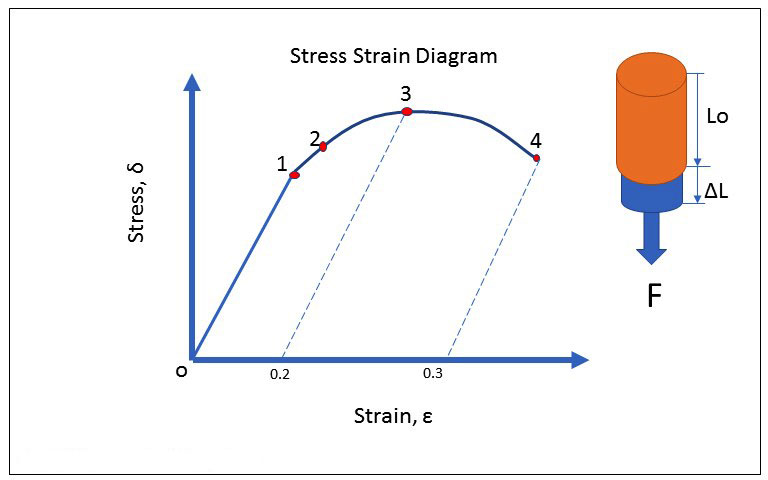
1. Stress-Strain Diagram
It is a diagram that demonstrates the stress and strain relationships as well as the elastic limit where the young's modulus is used and defined as the "elastic region" happens. The yield point, ultimate tensile stress, and the point of fracture are also specified.

To gather more information, go through the following link. nolmads.blogspot.com

Brief overview of working stress design & its parameters

~~~~~~~~~~~~~~~~~~~~~~~~
Published By
Rajib Dey
www.constructioncost.co
~~~~~~~~~~~~~~~~~~~~~~~~

Tuesday, May 17, 2016

Useful Construction Video Tutorial To Understand Blueprints And Drawing Scales

This construction video tutorial is presented by a group of professional estimators and construction personnel. The video will guide you to comprehend various drawing scales as well as how to ascertain the scale of drawing when the scale is not demonstrated on the drawing.

By watching this tutorial, you will be familiar with how to evaluate the exact scale concerning any blueprint or construction drawing. Blueprints, Construction Drawings or Building Plans require that large structures be represented by a fractional measurement to the real life size constructed building. If you have the capability to read mechanical drawings, you can be a successful Plumbing or HVAC estimator.


~~~~~~~~~~~~~~~~~~~~~
Published By
Rajib Dey
~~~~~~~~~~~~~~~~~~~~~

Thursday, September 17, 2015

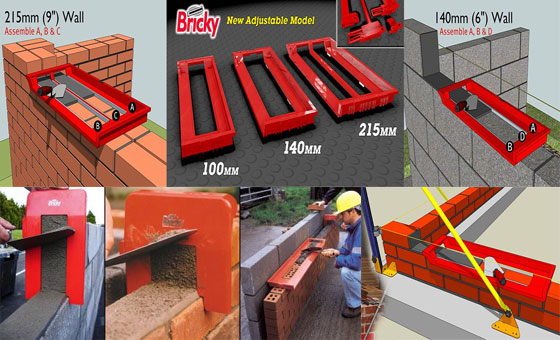
Bricky - An exclusive construction tool to provide a professional finish to your brick

Noel Marshall, the professional tool evaluator has developed Bricky. It is very useful for constructing wall in a structure.

With this construction tool, the builders can maintain a perfect standard following building regulation with constancy of walls. This construction tool is available in three different sizes 100 mm, 140 mm and 215 mm.

The tool makes sure that a precisely consistent bed of mortar is placed between courses of bricks and blocks. It perfectly works with standard brick and block on-edge construction in both US and Metric (W x D x H) dimensions:

Usefulness :-
  • Accurately spaced clean joints having no mess.
  • Produce your own brick planters, raised vegetable gardens, boundary walls, home extensions etc.
  • Give a superior quality professional finish to your brick with raised flower bed, BBQ, fire pit, firewood storage unit, brick or block fence or entrance wall, mailbox base, fish pond or water feature, garage, workshop, home addition, porch, or entryway.


For more information, visit bricky.com


Bricky Wall-Building Tool
Image Courtesy: bricky.com

~~~~~~~~~~~~~~~~~~~~~
Published By
Rajib Dey
~~~~~~~~~~~~~~~~~~~~~

Monday, August 24, 2015

How to get rid of concrete crack by using construction joints

Construction joint, expansion joint, contraction joints and isolation joints are the four types of joints generally found in Concrete Construction. They prevent the concrete from cracking. To get the optimum result, the exact position should be clearly identified before placing the construction joints in a concrete slab. Additionally, there are several types of joints in Concrete Structure, as stated below.

Materials for joints in water retaining structures and water tight structures:

  • Materials for joints in water preserving structures and water resistant structures for sewage and wastewater treatment will safeguard the construction from ethereal and close microbiological attack as well as gasoline, diesel oil, dilute acids and alkalis like hazardous materials.
  • Materials for joints in water preserving structures for drinkable and fresh water will adhere to the obligations of BS 6920.

Joint filler: Joint filler should be solid, elastic, single-thickness, non-decaying filler. Full depth of joint filers is designed to protect the joined ends. Joint filler for joints should be waterproof in water preserving structures and water repellent structures.

Bitumen solution: Bitumen composite for joints in water preserving structures and water-repellent structures will adhere to BS 3416. Bitumen composite for surfaces alongside which drinkable or fresh water will be preserved or transmitted, should adhere to BS 3416, type II.

Joint sealant: Joint sealant provides an effective and durable solution in concrete construction.

Joint sealant will maintain a grade to cope with the environmental conditions of Hong Kong and work perfectly over a temperature range of 0°C to 60°C. Joint sealant will remain grey for exposed joints.

Joint sealant except cold-applied bitumen rubber sealant will contain the following:-

  • A gun grade intended for horizontal joints, vertical joints and for disposed joints and having length 15 mm wide or less.
  • A pouring grade for horizontal joints having span over 15 mm.

Polysulphide-based sealant refers to a cold-applied two-part sealant that adheres to BS 4254. Polysulphide-based sealant meant for expansion joints in water preserving structures and water-resistant structures must contain a minimum 20% transverse butt-joint movement.

  • Polyurethane-based sealant refers to a cold-applied two-part sealant that adheres to the performance requirements of BS 4254.
  • Hot-applied bitumen rubber sealant shall compliant with BS 2499, type N1.
  • Cold-applied bitumen rubber sealant will be similar as proprietary type.
  • In table 1 given below, the description of Joint sealant for joints in water preserving structures and water resistant structures is provided.
  • The joint sealant manufacturer approves Primers and caulking material, to be applied with joint sealant, should be proprietary type.
  • Different types of joint sealant and primers which are combined with each other, will be congruent in nature.

Bond breaker tape: The Joint sealant manufacturer and the Engineer recommended and approved the Bond breaker tape like a proprietor type. The Bond breaker tape refers to a polyethylene film containing adhesive on one side and remains to be the complete width of the notch.

Bearing strip for sliding joints: The engineer recommended the Bearing strip for sliding joints that encompasses two plastic strips of a proprietary kind. These two plastic strips will protect from all weather conditions as well as chemicals to which the construction will be dependent devoid of weakening the reaction, sturdiness or utility of the strips.

Once it is set up, no maintenance work is required. The strips can combat with a vertical load of atleast three hundred kN/m2 and contain a most stable friction of 0.3 under a persistent cutting off force.

Water stops or Water stoppers: Water stops will range from natural or plastic rubber or extruded polyvinyl chloride and shall consist of the properties of density, hardness, lastingness, water absorption. Water stops, as well as intersections, educers and junctions, shall be of a proprietary type as recommended by the Engineer.

Construction joints are formed with the use of the specified materials. It will ensure that a better perception of material and proper choosing of water proofing material for various water retaining structures consisting of a durable waterproof system.

How to get rid of concrete crack by using construction joints

~~~~~~~~~~~~~~~~~~~~~~
Published By
Rajib Dey
~~~~~~~~~~~~~~~~~~~~~~
Tuesday, March 10, 2015

Download Civil Engineering Building Codes

Download Civil Engineering Building Codes
National Building code is actually bunch of rules which signifies the minimum standards of constructed as well as non-constructed objects. The main reason of building codes are to defend public health, safety and general welfare as they narrate to the construction and tenancy of buildings and structures.

The building code becomes law of an existing jurisdiction when officially enacted by the proper governmental or private authority. It has become law now.

Building codes square measure usually meant to be applied by architects, engineers, constructors and regulators however are used for numerous functions by safety inspectors, environmental scientists, land developers, subcontractors, and makers of building merchandise and materials, insurance firms.

The codes regulation the planning and construction of structures wherever adopted into law. Codes in developed western nations may be quite advanced and complete. They began in past and are developing ever since. Within the USA the most codes square measure the International industrial or Residential Code [ICC/IRC], electrical codes and plumbing, mechanical codes. Fifty states and also the District of Columbia have adopted the I-Codes at the state or territorial level.

Different codes could embody fireplace, health, transportation, producing, and different regulations/regulators/testers like UL; Underwriters Labs. In essence they're minimum standards of style and implementation.

Designers use ICC/IRC standards out of considerable reference books throughout style. Building departments review plans submitted to them before construction, issue permits and inspectors verify compliance to those standards at the positioning throughout construction.

There square measure usually further codes or sections of constant code that have a lot of specific needs that apply to dwellings or places of business and special construction objects like canopies, signs, pedestrian walkways, parking tons, and radio and TV antennas.
  • Download - National Building Code (Group 1)
  • Download - National Building Code (Group 2)
  • Download - National Building Code (Group 3)
  • Download - National Building Code (Group 4)
  • Download - National Building Code (Group 5)
National Building code is actually bunch of rules which signifies the minimum standards of constructed as well as non-constructed objects.

~~~~~~~~~~~~~~~~~~~~~~
Published By
Rajib Dey
~~~~~~~~~~~~~~~~~~~~~~