adsense analytic

Showing posts with label Shrinkage. Show all posts

Monday, December 23, 2019

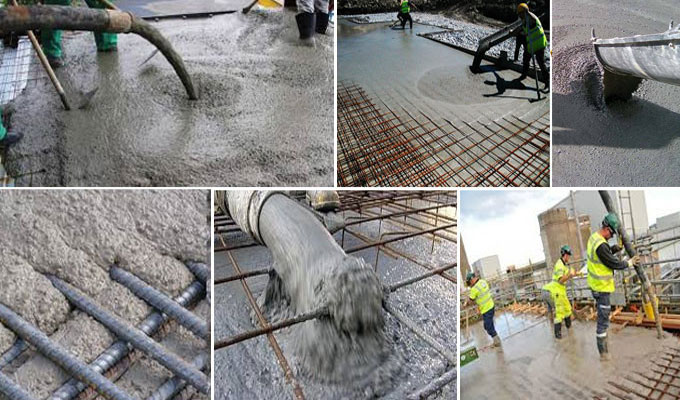
What is Self-Compacting Concrete and How is it used

Self-compacting Concrete, or Self-Consolidating Concrete, generally called SCC, is a fresh concrete that runs under its own weight and does not want external oscillation to undergo compaction. Constructors use SCC in the building structures where it is troublesome to use vibrators for the consolidation of concrete.
Why is Compaction Needed?
After the liquid or paste concrete is poured in place and should be left to set, it should undergo the compaction process before it starts to harden. Compaction or Consolidation significantly enhances the final strength of concrete and improves bonding with reinforcement. It also increases the abrasion resistance and overall sturdiness of the concrete. Moreover, this process decreases the permeability of concrete and helps to minimize its shrinkage and creep characteristics.
What is SCC?
The SCC or Self-compacting concrete is a form of concrete that can flow under its weight, and that does not need to go through a separate compaction process to fill and flow through heavy reinforcement areas.
SCC has more or less equivalent cement binders and water ratios as the standard concrete mix. However, the variations in the mix cause the SCC to produce a higher strength without vibrating the concrete by forming better bonds between the hardened paste and the aggregates and reinforcements. You can pour SCC into structures more than five meters tall because due to its characteristics the aggregates will not get segregated. The self-compacting concrete can also be poured faster than the regular mix.
What are the Materials in SCC Mix?
To give the concrete paste diverse properties, somewhat different materials ratios are used in the SCC mix. These are as follows.
Cement: Grade 43 cement is used in self-compacting concrete, which must meet the physical properties according to IS:8112 code. The following table will give a better understanding of the cement used in SCC
What is Self-Compacting Concrete and How is it used
~~~~~~~~~~~~~~~~~~~~~~~~~~
Published By
Rajib Dey
www.constructioncost.co
~~~~~~~~~~~~~~~~~~~~~~~~~~

Tuesday, July 9, 2019

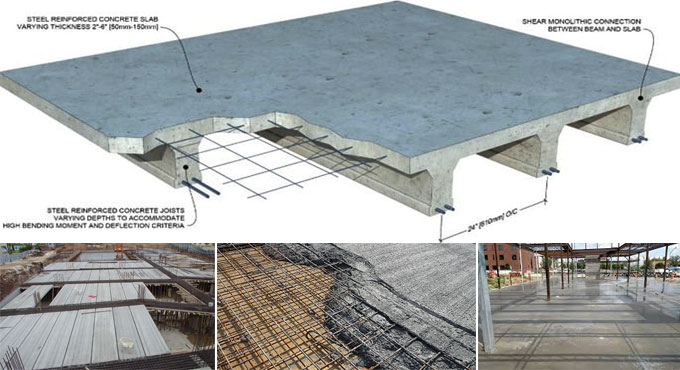
How to get rid of common errors in concrete floor slab construction

To get rid of common errors in concrete floor slab construction, various steps like perfect base preparation, mix design, placement, finishing, and curing should be taken.

Typical concrete floor slab thickness in residential construction should be 4 inches. In case the concrete has to sustain extreme loads irregularly, the thickness should be five to six inches; as for instance, motor homes or garbage trucks.

To arrange the base, the ground level should be dug according to the perfect depth to provide for the slab thickness. Take out all organic material and large hard objects like stones and tree roots to a depth of minimum 4 inches. If it is required to develop the grade, apply gravel or sandy soil, and compress the final base with a vibratory plate or equivalent device.

The edge is built up with any straight material that can be fixed into position. If case of constant non-availability of straight lumber, plastic or metal forms should be used. Fix a string line with grade stakes or batter boards to provide a square, level reference prior to place the formwork.

For the concrete mix, it should satisfy the compressive strength requirements (normally 3000 pounds per square inch) devoid of measures that lead to extreme shrinkage. The shrinkage and cracking are increased because of the existence of water, a plasticizer should be used to attain required slump.

Also provide fibers to check plastic shrinkage cracking. Greater strength and entrained air are necessary for exterior slabs susceptible to freezing weather or deicing chemicals.

It is suggested not to add water at the jobsite more than 1 to 2 gallons per cubic yard. In case, extra slump is essential, take advice from the mixer truck driver concerning the quantity of water to be included devoid of taking the concrete out of specification.

Spread the concrete accross the slab area as close to its final position as possible, and then rake it into exact location. Hardens low-slump mixes manually with a vibrator or apply a vibratory screed. Complete with the least force and strokes of the float required to attain a smooth surface.

Develop control joints no farther apart than 24 to 30 times the slab thickness and at no time exceeding 15 feet along both the width and length of the slab by pushing a 1-inch deep grooving tool into the surface.

To keep Joint spacing more than 15 feet, different types of load transfer devices should be used which range from dowels or dowel plates. For slabs with long joint spacing or no joints, steel reinforcement will be suitable.

It will raise the chances for random cracking, but will maintain cracks firmly to keep up superior structural performance.

The curing process should be initiated when the finished surface can counter damage. The concrete should not be enabled to freeze or dry out. Arrange a curing compound over the surface, or apply proper moist curing.

In case of freezing, the slab should be wrapped with an insulator, like insulating blankets or a 4-inch-thick layer of straw that is weighted down so that it can’t blow away. Unless the concrete attains a strength of minimum 500 psi, put the insulator in place. It normally happens within a few days.

Read more

How to get rid of common errors in concrete floor slab construction

~~~~~~~~~~~~~~~~~~~~~~~~
Published By
Rajib Dey
www.constructioncost.co
~~~~~~~~~~~~~~~~~~~~~~~~