adsense analytic

Showing posts with label Bleeding. Show all posts

Tuesday, October 1, 2019

How to prevent segregation of concrete

Definition of Segregation of Concrete?
Major components of concrete are cement, sand, aggregate, and water. Normally, a coating is made to concrete aggregate with cement and sand for developing the consistent mass disjointing of these constituent materials of concrete from each other. It is known as segregation of concrete.
Type of segregation:
1. Partition of course aggregate from the paste.
2. Partition of course agreement paste from the concrete.
3. Partition of water from the cement mix which is also known as bleeding.
The segregation contains unwanted properties in the hardened concrete. It also leads to honeycombing in concrete. Segregation also adversely impacts on stability, compressive strength and all other characteristics of concrete. It also results in forming cavities in the concrete surface.
Reasons for segregation:
The segregation mainly occurs due to the variation in specific gravity and size of its constituent material. Specific gravity of water is 1. Specific gravity of cement is approx 3.15 whereas that of aggregate is 2.6 to 2.7. Because of the variation in specific gravity, lighter particle goes upwards and heavier particle goes downwards and consequently the segregation of concrete occurs.
Other reasons range from greater water cement ratio in concrete. Besides, when excessive water is added at the time of mixing concrete, it results in segregation. Improper vibration for a long period on wet mix of concrete also causes heavy material to setting down and lighter cement sand paste to move upwards. Imperfectly proportioned mix and inappropriate placing on site may also lead to segregation.
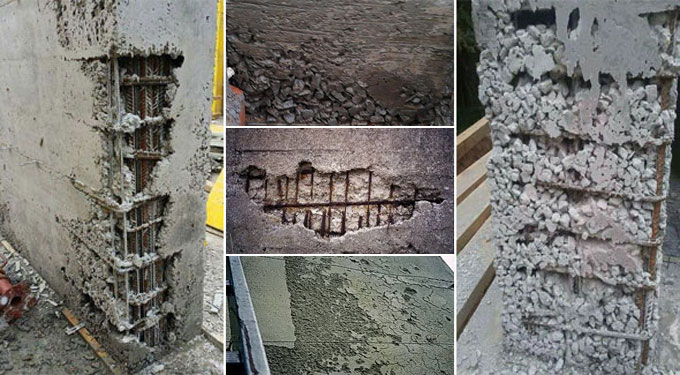
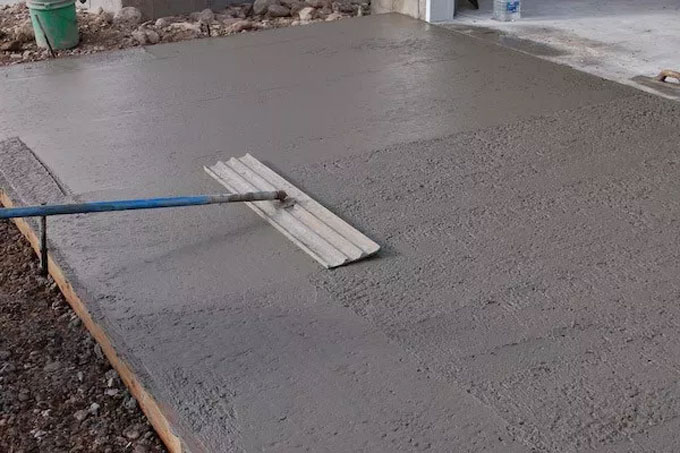
How to prevent segregation of concrete
~~~~~~~~~~~~~~~~~~~~~~~~~~
Published By
Rajib Dey
www.constructioncost.co
~~~~~~~~~~~~~~~~~~~~~~~~~~

Wednesday, August 28, 2019

Effect of segregation and bleeding on quality of concrete

Segregation in concrete: Segregation means the detachment of ingredients in concrete. In concrete, the following types of segregations mainly occur:-
1. Detachment of coarse aggregate from the concrete mixture,
2. Detachment of cement pastes from the concrete throughout its plastic phase.
3. Detachment of water from the concrete mix (Bleeding in concrete)
Concrete is formed by mixing cement, fine and coarse aggregates. In a standard quality concrete, is all the ingredients are grouped properly to develop a uniform mixture. Segregation in concrete is primarily occurred due to variations in specific gravities of the ingredients.
Specific gravity of Cement remains among 3.1-3.6g/cc, and for aggregate it remains among 2.6-2.7g/cc. Because of this variation, the aggregate is detached from the matrix and segregation in concrete occurred.
There are various other factors to create segregation in concrete :-
1. Moving concrete mixes for long distances.
2. Weak mix ratio, where adequate matrix does not exist to unite the aggregates.
3. When concrete falls from over 1m.
4. Vibrating concrete for a prolonged period.
Guidelines to reduce segregation in concrete:-
Segregation is managed properly with exact mix ratio.
Handling, placing, transporting, compacting and finishing of concrete in perfect manner.
With the addition of air entraining agents, admixtures and pozzolanic materials in the mix, the segregation is controlled to some extent.
Bleeding in concrete: Bleeding is a type of segregation in which existing water in the concrete mix is forced upwards owning to the settlement of cement and aggregate. Since specific gravity of water is low, the water may proceed upwards. Bleeding normally occurs in the wet mix of concrete.
Due to greater amount of water cement ratio, the bleeding is found in concrete. If the water-cement ratio is higher, the concrete becomes weak and as a result excessive bleeding happens.
The bleeding in concrete is not a cause of great concern when the rate of evaporation of water is identical to the rate of bleeding. Normal bleeding improves the workability of concrete.
When the concrete becomes completely plastic, bleeding is not injurious. However, concrete still remains in the plastic stage and it is subsidized and compacted in due course.
How bleeding impacts the stability of concrete :-
1. Since water is pushed upwards in bleeding, sometimes with this water, specific amount of cement proceeds together with water to the concrete surface. If the top surface is worked up with the trowel, the aggregate comes downward and cement paste is developed at the top surface and it is known as ‘Laitance in concrete.’ As Laitance is developed, the wearing strength of structure is reduced and the longevity of structure is hampered.
2. While directing to the top from bottom, water produces continuous channels. Because of these channels, concrete turns out to be porous and facilitates water to move, that develops water voids in the matrix and decreases the bond among aggregate and the cement paste.
3. If water is accumulated at the top surface of concrete, the surface finishing is deferred.
4. Concrete becomes porous and its consistency is affected.
5. Excessive bleeding results in rupturing the bond among the reinforcement and concrete.
Remedies to control the bleeding :-
1. Bleeding in concrete is managed with the inclusion of minimum water content in the concrete mix.
2. Allowing the application of air en-training admixtures in the mix.
3. By providing more cement in the mix.
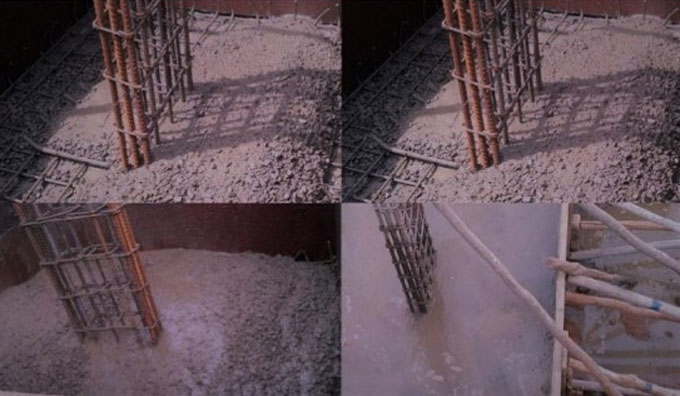
Effect of segregation and bleeding on quality of concrete
~~~~~~~~~~~~~~~~~~~~~~~~~~
Published By
Rajib Dey
www.constructioncost.co
~~~~~~~~~~~~~~~~~~~~~~~~~~
Friday, July 5, 2019

Some vital tests to check the quality of concrete

Concrete is mainly a composite material that comprises of fine & coarse aggregate, water, cement, and admixtures.

To obtain high-quality concrete, the sample should be examined thoroughly to ensure whether it is formed according to requirement or not. If the test for concrete is not conducted, the following problems will occur :-

• Cracks and voids in the finished concrete.
• The concrete of Low compressive strength.
• Bleeding


Given below, the details on some vital tests of concrete:

1. Workability test
2. compressive strength test
3. Non-destructive test
4. Destructive test
5. Durability test


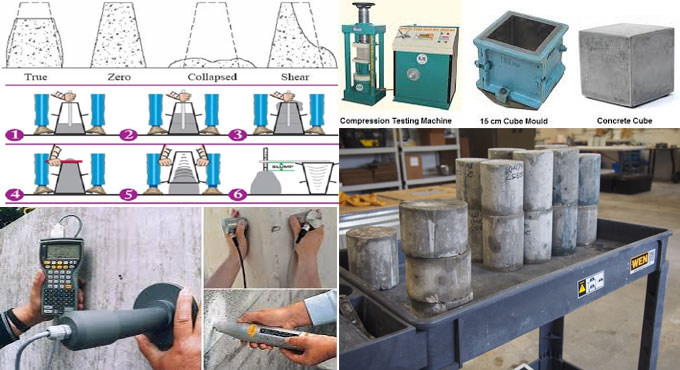
WORKABILITY TEST: Workability test plays a crucial role since it is associated with the strength of concrete. Workability means the capacity to fill the mould perfectly with the vibrator but the quality of concrete is not affected. The Workability of concrete is calculated with the following test:

• SLUMP TEST
• VEE-BEE TEST
• COMPACTING FACTOR TEST


Compressive strength of concrete: The concrete can’t sustain the compressive load. So, it becomes essential that any concrete member could withstand a good amount of compressive load.

Under this test, the maximum compressive strength of the concrete sample is ascertained after 28 days of curing. Based on the standard code of India, 150 mm concrete cubes are utilized in this test. Under this test, the concrete sample should be immersed for 28 days and after each 7 days water should be changed. After 28 days of curing, the concrete specimen is arranged on the machine plate.

Now load is provided slowly to the specimen unless the collapsing of the concrete cube occurs. Destructive and Non-destructive Test of Concrete These tests are carried out to find out the compressive strength of the existing concrete structure where the required concrete sample is not available.

This types of tests are conducted with the destructive or Non-destructive way.

If Non- destructive way is followed, compressive strength should be established devoid of affecting the structure or any concrete member. The Non-destructive test is conducted on the following ways :

• Rebound hammer test
• Penetration and pullout techniques
• Surface hardness test
• Radio-active method


Most common Destructive tests are as follows:

• Concrete core test
• Cube test
• Tensile strength test


Durability Test: With the purpose of maintaining the sustainability of concrete, the stability of concrete is required. To enhance the stability of concrete, it's vital that concrete should contain the following qualities :

• Water resistance
• Chloride attack resistance
• Resistance to infiltration of water.


Read more

Some vital tests to check the quality of concrete

~~~~~~~~~~~~~~~~~~~~~~~~
Published By
Rajib Dey
www.constructioncost.co
~~~~~~~~~~~~~~~~~~~~~~~~

Monday, April 8, 2019

Tips to reduce bleeding in concrete

Concrete is formed by mixing cement, fine aggregates and course aggregates. If process for mixing, curing and placing is inaccurate, several issues may arise. Bleeding in concrete is one of the vital issues. Bleeding means a type of segregation, in which water emerges out of concrete.
Bleeding in concrete happens if the course aggregates is like to settle down and free water in the mix moves up to the surface and produces a paste of cement on the surface called “laitance”. This upward transition of water at the time of penetrating from bottom to top, creates continuous channels. If the applicable water cement ratio is 0.6 or more, the bleeding channels will be continuous.
Penetration in the structure occurs due to these continuous bleeding channels. While upward transition is going on, the water is stored underneath the aggregates and forms water voids and minimizes the bond among the aggregates and paste.
In the same way, the water that is stored underneath the reinforcing bars minimizes the bond among the reinforcement and concrete. When bleeding remains at normal rate, it is not harmful but high rate of bleeding can lead to damage of bond.
Reasons for bleeding: Bleeding in the concrete mix is caused by segregation. For segregation, heavy aggregate particles are settled down and owing to this water moves up to the surface and develops a layer. This upward transition of water also conveys the fine particles of cement with it. The top surface of slabs and pavements will not contain superior wearing quality.
Bleeding mostly operates on the surface of concrete, when water to cement ratio is greater. The rate of bleeding is based on the type of cement utilized, quantity of fine aggregate.
Impacts Of Bleeding:
1. Because of bleeding, the consistency of concrete is lost.
2. Due to bleeding, permeability in concrete occurs.
3. The water stored underneath the reinforcing bars, decreases the bond among the reinforcement and concrete.
4. While bleeding is going on, the storage of water develops a water voids and minimizes the bond among the aggregate and cement paste.
5. Because of bleeding, pumping ability of concrete is decreased.
6. Bleeding raises the water-cement ratio at the top.
7. The storage of water at the top leads to delayed surface finishing.
Some useful steps to minimize bleeding:
1) Put in minimum water content in the concrete mix, chemical admixtures should be applied to minimize the quantity of water to maintain desired workability.
2) Design the concrete mix correctly.
3) Apply fly ash or other additional cementitious materials.
4) Air entraining admixtures is useful for minimizing the bleeding.
5) Put in extra cement in the mix.
6) The amount of fine aggregate should be raised when sand is coarser (fineness modulus of 2.5 to 2.8 is recommended) in mix and lessen aggregate proportionately.
There should be perfect precautions throughout formation of mix and method of mixing to lessen bleeding as it leads to weak structure and an interruption in construction cycle.
Tips to reduce bleeding in concrete

~~~~~~~~~~~~~~~~~~~~~~~~~~
Published By
Rajib Dey
www.constructioncost.co
~~~~~~~~~~~~~~~~~~~~~~~~~~