adsense analytic

Showing posts with label construction article. Show all posts

Saturday, August 20, 2016

Some useful construction tips for quality control of concrete throughout construction

This article is extracted from an exclusive construction article written by KAUSHAL KISHORE, well know consulting material engineer, and RAKESH SHARMA, Vice President Project of M/s Supertech Limited.

If the concrete is contacted with superplasticizer, it behaves the same way when the amount and type of sulfate included with the clinker. The rheological and setting Behavior are modified on the basis of whether the sulfate is included as anhydrite, hemihydrates, or gypsum. The variations are described by the various rates of dissolution of these sulfates.

It is crucial to keep in mind that all admixtures relevant to the similar generic type may not behave in the same way in concrete due to the differences in the molecular weight, cautions involved with them, chain length, etc. Correspondingly, the similar type of cement generically is dissimilar in mineral, alkali and sulfate contents, and fineness.

As per IS: 456-2000, admixture should not weaken strength of concrete neither mix with the component to develop injurious compounds as well as not enhance the chance for the growth of corrosion in reinforcement. The feasibility, compressive strength and the slump loss of concrete with or without the application of admixtures should be determined throughout the trial mixes prior to applying admixtures. If two or additional admixtures are applied all together in the similar concrete mix, data should be captured to evaluate their interaction as well as certify their compatibility.

The admixtures, the materials for forming concrete and their compatibility can influence the performance of concrete admixture along with superplasticizers. It is essential to analyze concrete admixtures so that it can be exactly used with the concrete to transform materials and mix proportions for being used on the work under proper field conditions.

There four primary components in Cement which range C3s, C2s, C3A and C4AF. Besides, there lots of negligible oxides like K2O and Na2O, MgO and SO3. These are supplied by gypsum and included in the final phases of cement manufacture as a set regulator. If there exist less C3A, superplasticizer would be get immersed in higher amount on C3S and C2S, causing a drop in the strength development.

To read the complete article, go through the following ink

Quality Control Of Concrete

~~~~~~~~~~~~~~~~~~~~~
Published By
Rajib Dey
~~~~~~~~~~~~~~~~~~~~~

Thursday, June 16, 2016

Some Useful Construction Tips For Replacing Shingle Roof

This construction article provides detailed guidelines for substituting shingle roof, setting new roof, extracting old roof as well as eliminating flashings.

The construction video will be useful to undertake repair, and precautionary maintenance, along with safeguarding and roof leak repair toward the industrial, and home residential buildings.

If your roof surpasses 20 years old and most of the shingles are severely defective or critically worn, it should be replaced immediately because through damaged roof water can seep under the shingles and rot the wood sheathing below.


~~~~~~~~~~~~~~~~~~~~~
Published By
Rajib Dey
~~~~~~~~~~~~~~~~~~~~~
Tuesday, September 22, 2015

Brief overview of Seismic designs for masonry building

The National Building Code of Canada 2005 (NBCC 2005) and the CSA S304.1-04 masonry design standard are two useful construction documents which facilitate the structural engineers to create design for masonry buildings toward seismic load effects.

This article offers a explanation on the elementary theoretical background and theory for the CSA S304.1-04 seismic design provisions. Modifications in the seismic design provisions are described in Part 4 of the NBCC 2005 and CSA S304.1-04, as well as how these affect the masonry design and construction.

This document provides a detailed up-to-date guide on seismic design and building of masonry structural elements for low to mid-rise structures, like warehouses, industrial buildings, schools, commercial buildings, and residential/hotel structures. This construction article mainly focuses on how to apply concrete block units for designing and construction of masonry structures.

Learn the use of seismic design provisions and cross-referencing of code clauses for designers. The addendums consist of some helpful documentations like design processes and research background toward some of the design provisions. The applicable code clauses are provided through framed boxes wherever required.

Chapter 1 offers the assessment of the general seismic design provisions described in Part 4 of NBCC 2005, together with seismic hazard levels, and the relevent static force processes. One can learn the primary design parameters which range from irregularities, torsion, height limitations, and the ductility and overstrength features for masonry structures. Besides, there is an explanation to the dynamic analysis of structures to simplify the suitable code provisions. As lots of updates are made to the seismic provisions in NBCC 2005, relevancies with the earlier 1995 edition of the building code are also provided in Appendix A.

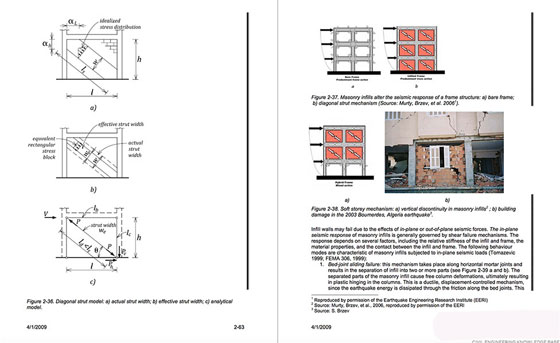
Chapter 2 contains an explanation of seismic design needs for reinforced masonry walls. Applicable CSA S304.1-04 design needs are provided together with concerned commentary having brief interpretation concerning code provisions. Here topics covered reinforced masonry shear walls based on in-plane and out-of-plane seismic loads, as well as a eloborate explanation of the CSA S304.1 seismic design needs. Some exclusive topics like masonry infill walls, stack pattern walls, masonry veneers, and construction-related issues are also covered. Amendments in CSA S304.1-04 seismic design needs from the earlier (1994) edition are explained and discussed,together with their design suggestions. Appendix B includes topics associated with the Chapter 2 content which range from findings of research studies and foreign code provisions concerning seismic design of masonry structures.

Chapter 3 sum ups differentiations in seismic design provisions explained in the 1995 and 2005 editions of NBCC, and the 1994 and 2004 editions of CSA S304.1. Designers having ideas on the brief seismic and masonry design problems naratted in Chapters 1 and 2, can shift directly to this summary chapter. The differentiations in code provisions are explained in a tabular format. This chapter also synopsizes the viii results of a case study concerning a typical warehouse building designed following NBCC 1995 and NBCC 2005. This construction artilce also focus on three Canadian locationsdefined by various seismic hazards (Vancouver, Calgary, and Toronto).

Chapter 4 offers explanatory design instances of seismic load estimates and allocation of forces to members as per NBCC 2005, and the design of loadbearing and nonloadbearing masonry elements to CSA S304.1-04. The outline of masonry buildings and the mechanical characteristics of their components in the examples are provided to cope up with the circumstances often faced in design practice, specifically when these associated with the torsionally unsymmetric buildings. These explanations set out in a progressive manner, involving adequate examples and proper demonstrations required to modify the design process. Appendix C offers related background information toward the design examples, along with an comprehensive discussion of in-plane wall stiffness. Appendix D offers design assistances applied in the Chapter 4 examples.

Seismic Design Guide for Masonry Buildings download

Seismic Design Guide for Masonry Buildings

~~~~~~~~~~~~~~~~~~~~~~
Published By
Rajib Dey
~~~~~~~~~~~~~~~~~~~~~~